
Yes, you can use toner while pregnant, but the formula matters. Many gentle, hydrating toners can stay in your routine during pregnancy. What deserves a closer look is the ingredient list, especially if your toner contains retinoids, strong exfoliating ingredients, hydroquinone, or other concentrated actives.
If you’re reviewing your routine more broadly, you need to take a look at Bella B’s pregnancy-safe skincare products.
And if the toner you loved before pregnancy suddenly makes your face feel tight, stingy, or generally unhappy? Your skin may simply be playing by new rules now. Pregnancy can change oil production, sensitivity, acne, and pigmentation, so the toner that worked six months ago may not be the toner your skin wants today.
Can You Use Toner While Pregnant?
You usually can.
The word toner describes a whole category of products rather than one particular formula. One bottle might be little more than a lightweight hydrating step. Another may contain exfoliating acids, acne-fighting ingredients, or anti-aging actives.
That’s why asking, “Is toner safe for pregnancy?” is a bit like asking whether soup is spicy. We need to know what’s actually in it.
Pregnancy itself can also change your skin. You may notice acne, dark patches such as melasma, or other changes you never dealt with before. The American College of Obstetricians and Gynecologists’ guidance on skin conditions during pregnancy explains that acne and melasma are among the skin changes that may occur during pregnancy.
Instead of automatically throwing out your entire skincare shelf, start by checking the ingredients in the products you already use.
And remember: toner isn’t mandatory.
If your skin is happy with a gentle cleanser, moisturizer, and sunscreen, you don’t earn extra skincare points for squeezing another bottle onto the bathroom counter. A toner is useful when it gives your skin something it actually needs.
Why Your Old Toner May Feel Different During Pregnancy
Pregnancy hormones can make skin surprisingly unpredictable.
You might have spent years battling an oily T-zone only to wake up one morning wondering who replaced your face with the Sahara. Or perhaps your normally calm skin has decided that now is an excellent time for breakouts.
These changes matter when choosing a toner during pregnancy.
A strong astringent that once made oily skin feel squeaky clean may now leave your face dry or irritated. An exfoliating toner you previously used every night may suddenly feel too aggressive.
This is one reason a simpler routine often makes sense during pregnancy. Instead of trying to fight every new bump, dry patch, and dark spot at once, ask what your skin needs today.
Dry or tight? Prioritize hydration.
More sensitive than usual? Look for a simple, gentle formula.
Breaking out? Talk with your dermatologist or OB-GYN about pregnancy-appropriate acne ingredients rather than throwing every acid in your cabinet at the problem. The American Academy of Dermatology’s pregnancy acne guidance is also useful if acne is becoming part of the picture.
Your skin doesn’t need a chemistry experiment before breakfast.
What to Look for in a Toner for Pregnant Women
If you’re shopping for a safe toner for pregnant women, turn the bottle around before falling for whatever sounds lovely on the front.
Here are a few things worth looking for.
Hydrating Ingredients
Pregnancy isn’t necessarily the time to chase that old-school, squeaky-clean toner feeling.
Ingredients that support hydration can be especially useful if your face feels dry or tight after cleansing. Hyaluronic acid, glycerin, aloe, and other moisturizing ingredients can help a toner act as a light hydration step before serum or moisturizer.
Think refreshed, not stripped.
Niacinamide
Niacinamide is another ingredient you may see in modern facial toners. It can support the skin barrier and is commonly used in products designed for uneven-looking, oily, or sensitive skin.
It can be particularly handy when pregnancy has somehow left your skin feeling dry and oily at the same time. Thanks, hormones.
Gentle Botanical Ingredients
Plant-derived ingredients can provide soothing or hydrating benefits, depending on the formula.
But don’t assume that “natural” automatically means pregnancy-safe or irritation-proof. Poison ivy is natural too, and nobody is volunteering to rub that on their cheeks.
Look at the whole formulation rather than relying on one comforting word on the label.
A Formula That Matches Your Skin Now
This part is easy to overlook.
Choose your face toner while pregnant for the skin you currently have, not the skin you had before your positive pregnancy test.
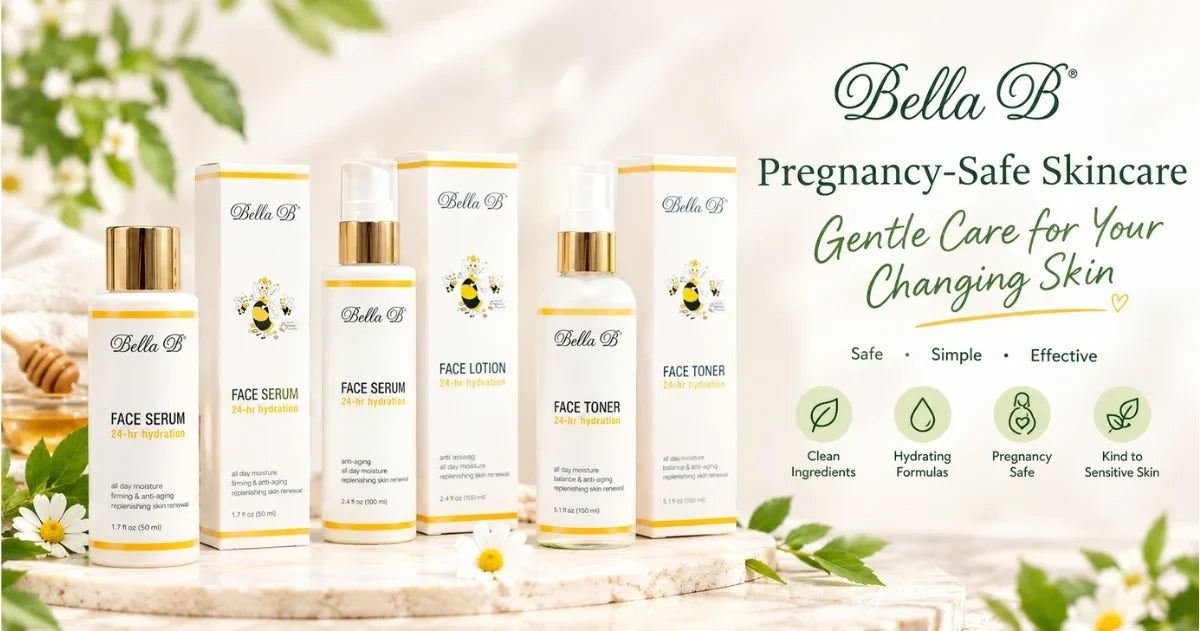
If pregnancy has made your skin more sensitive, a mild hydrating toner may make more sense than a powerful exfoliating formula. Bella B’s pregnancy-safe Face Toner is formulated as a hydrating, fragrance-free option for sensitive skin and pregnancy.
If you’re dealing with acne or pigmentation, ask your healthcare provider which active ingredients and concentrations make sense for you.
|
Quick label check |
What it means |
|
Hydrating ingredients |
Good for dry or tight-feeling skin |
|
Salicylic / glycolic acids |
Review strength + frequency |
|
Retinoids + hydroquinone |
Avoid during pregnancy |
Toner Ingredients to Avoid or Review During Pregnancy
This is where label-reading becomes important.
Retinoids
Retinoids are vitamin A derivatives used for acne and anti-aging. During pregnancy, dermatologists recommend avoiding topical retinoids, including retinol and prescription options such as tretinoin and tazarotene.
The American Academy of Dermatology’s pregnancy skincare recommendations specifically list retinoids among ingredients to avoid while pregnant.
So if your “brightening,” “renewing,” or “anti-aging” toner contains a retinoid, put that one on maternity leave.
Check labels for terms including:
- retinol
- retinal or retinaldehyde
- tretinoin
- adapalene
- tazarotene
When you’re unsure about a vitamin A derivative, show the ingredient list to your OB-GYN or dermatologist.
Hydroquinone
Hydroquinone is used to lighten areas of hyperpigmentation. Pregnancy can bring pigmentation concerns such as melasma, which can make a brightening product very tempting.
However, the American Academy of Dermatology recommends avoiding hydroquinone during pregnancy.
Instead of trying to attack every dark spot immediately, keep sun protection high on your priority list and speak with your healthcare provider about pregnancy-appropriate options.
What About Salicylic Acid?
This one causes a lot of internet confusion.
Salicylic acid is often found in acne and exfoliating toners. The American College of Obstetricians and Gynecologists lists topical salicylic acid among over-the-counter ingredients that can be used during pregnancy.
The American Academy of Dermatology adds some nuance, recommending that higher-dose salicylic acid above 2% be used sparingly and discussed with your dermatologist.
So you don’t need to panic because you spotted the words “salicylic acid” on a label. But concentration, frequency, the area being treated, and the rest of your routine matter.
If you’re using a stronger exfoliating toner, ask your healthcare provider instead of relying on a TikTok comment section as your prenatal dermatology department.
Glycolic Acid
Glycolic acid is another exfoliating ingredient that creates confusion.
ACOG’s pregnancy skin guidance includes glycolic acid among over-the-counter ingredients that can be used during pregnancy.
Still, pregnancy can make skin more reactive, and piling exfoliating products on already-sensitive skin isn’t necessarily a good idea just because an ingredient is permitted.
If you’re using a concentrated acid treatment rather than a basic toner, discuss it with your healthcare provider.
Strong Alcohol-Based or Highly Fragranced Toners
These aren’t necessarily a pregnancy danger in the same category as retinoids. The concern is often irritation.
If your toner leaves your face feeling tight enough to play a drum solo on it, that’s not a badge of effectiveness.
Gentle usually wins.
If you’re checking other products in your routine too, Bella B’s guide to pregnancy-safe skincare ingredients can help you quickly see which ingredients are generally worth keeping and which ones deserve a closer look.
Do You Actually Need Toner During Pregnancy?
No. And this is probably the most useful thing nobody tells you while you’re comparing twelve bottles online.
Toner is optional.
A basic pregnancy skincare routine can be wonderfully boring:
Gentle cleanser → treatment or hydrating step if needed → moisturizer → sunscreen in the morning.
That’s it.
If you want to keep the routine simple, start with a gentle pregnancy-safe Face Wash and follow with the products your skin actually needs.
If a toner makes your skin feel comfortable, hydrated, and refreshed, great. Keep the step. If you’re using it because you’ve been told skincare routines are somehow incomplete without toner, you can give yourself permission to skip it.
Your routine should solve problems, not collect products.
Choosing a Pregnancy-Safe Toner Without Overthinking It
When you’re standing in the skincare aisle wondering whether you need a degree in cosmetic chemistry, use a simpler checklist.
First, check whether the product contains retinoids or hydroquinone. Next, look at stronger active ingredients and their concentrations. Then ask whether the formula actually suits your current skin. Finally, consider irritation.
A toner safe for pregnancy doesn’t have to perform seven different jobs. Sometimes the smartest choice is simply one that refreshes and hydrates without turning your routine into another thing you need to worry about.
Bella B’s Pregnancy Safe Face Toner is designed with exactly that simpler approach in mind. It’s a hydrating, fragrance-free toner formulated for pregnancy and sensitive skin, with organic ingredients, natural oils, fruit extracts, plant extracts, and ocean plant extracts.
It fits after cleansing and before your serum or moisturizer, so you don’t need to reinvent your entire routine just to add it.
The goal isn’t more skincare. It’s skincare that makes sense for what your skin is doing now.
How to Use Face Toner While Pregnant
Once you’ve checked that your toner is appropriate for pregnancy, using it is pretty straightforward.
Cleanse your face gently first. Then apply your toner according to its directions, either with clean hands or a cotton pad.
If your skin needs another hydration step, you can follow with a lightweight pregnancy-safe Face Serum and finish with moisturizer. Bella B’s Face Lotion is another option for lightweight daily hydration.
During the day, don’t forget sunscreen. Pregnancy-related hormonal changes can contribute to melasma and other pigmentation changes, making sun protection especially important. ACOG identifies melasma as one of the common skin changes that may occur during pregnancy.
And don’t introduce five new products at once.
If your skin suddenly reacts, you’ll have no idea which member of your shiny new skincare squad started the drama.
Introduce products gradually and pay attention to how your skin responds.
What About a Breastfeeding-Safe Toner?
If you’re planning ahead, you may also be wondering whether the rules change after your baby arrives.
Many gentle toners can also be used while breastfeeding, but pregnancy and breastfeeding recommendations aren’t identical for every active ingredient or medication.
Bella B’s Face Toner is formulated for continued use during breastfeeding as well as pregnancy.
That’s another reason not to rely only on a “clean,” “natural,” or “mom-safe” claim on the front of a bottle.
Check the actual ingredients and ask your healthcare provider about stronger active products, particularly if you’re restarting treatments you stopped during pregnancy.
When Should You Ask Your Dermatologist or OB-GYN?
You don’t need to call your doctor every time you see an ingredient with six syllables.
You should ask when you’re using prescription skincare, stronger chemical exfoliants, acne treatments, unfamiliar active ingredients, or a product you’re simply uncertain about.
You should also speak with a dermatologist if pregnancy brings significant acne, rashes, irritation, or other skin changes that aren’t improving.
Bring the product or a photo of the ingredient list. That’s much more useful than asking, “Can I use toner?”
Remember, two products can both say “toner” on the front and contain completely different ingredients.
The Bottom Line
So, can you use toner while pregnant? In most cases, yes, as long as you’re paying attention to the formula rather than assuming every toner is the same.
Look for gentle hydration, choose products for the skin you have now, avoid retinoids and hydroquinone, and be more thoughtful with stronger active ingredients.
Most importantly, don’t let pregnancy skincare turn into another full-time job. Your bathroom shelf doesn’t need a complete identity crisis because you’re pregnant. A few well-chosen products, a good moisturizer, daily sunscreen, and professional advice when you’re unsure can take you a long way.
