
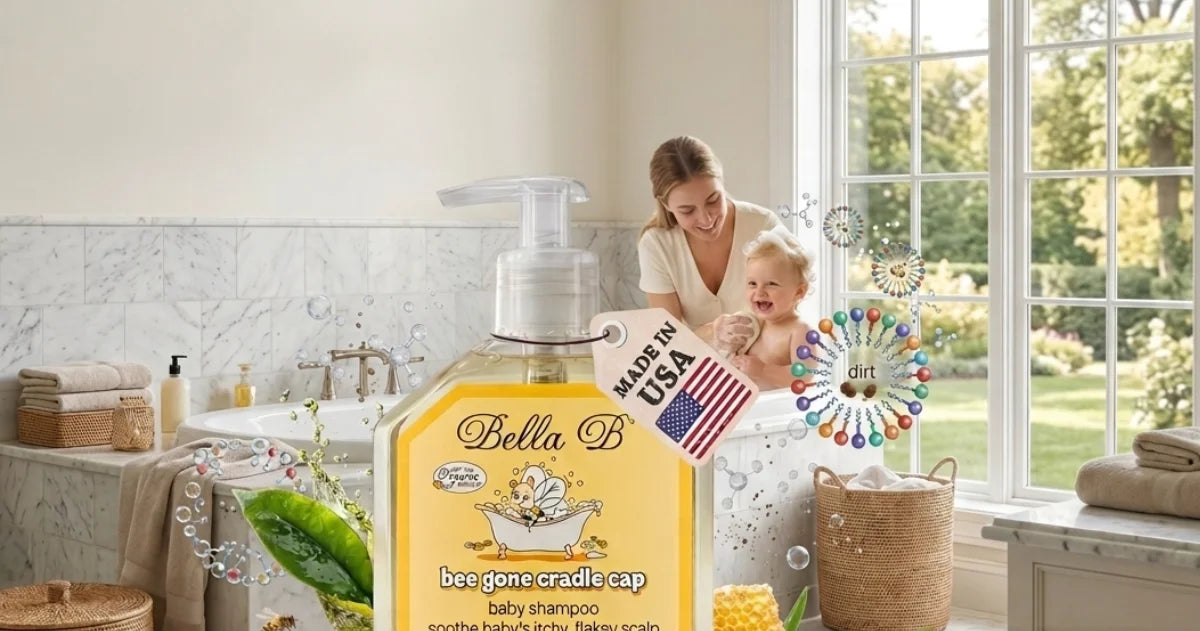
Bath time can make a small label feel like a big decision. You're trying to keep water out of your baby's eyes, manage the wriggling, and not make dry skin or scalp flakes worse. Then you look at the bottle and see "soap-free." And the question comes up fast: if there's no soap in this, how is it actually cleaning my baby's hair? At Bella B Naturals, this is one of the questions we hear most from parents building out their baby bath routine, so let's walk through exactly what's happening in that bottle.
Quick Answer
Soap-free baby shampoo still cleans your baby's hair and scalp just as effectively as traditional shampoo. It just does the job differently. Instead of alkaline soap, it relies on gentle surfactants and cleansing agents, like decyl glucoside and coco glucoside, that lift away oil, sweat, and milk residue without disturbing your baby's delicate skin barrier. These amphoteric surfactants are typically part of a pH balanced shampoo or soap free cleanser system, which is why formulas like this tend to be gentler on sensitive skin, dry scalps, and cradle cap-prone areas. Bella B builds its baby skincare products, including Squeaky Bee Hair and Body Wash and Bee Gone Cradle Cap Shampoo, around exactly this kind of mild cleanser approach, so parents get real cleansing power without the harshness of traditional soap.
So the label does not mean "this won't clean." It means "this cleans without relying on traditional soap."
Our soap-free baby shampoo uses mild cleansing ingredients called surfactants instead of traditional soap, as used in formulas like Bella B Squeaky Bee Hair and Body Wash. These cleansing agents help lift away oil, milk residue, sweat, and everyday buildup so they can rinse off with water. Infant skin care guidance supports mild cleansers for babies, and research notes that water alone is not always enough to remove all impurities during bathing.
What Does "Soap-Free" Baby Shampoo Mean?
"Soap-free" usually means the formula does not use traditional alkaline soap. Instead, it relies on a soap free cleanser system designed to wash away dirt and oil while being more suitable for baby skin. Expert guidance for newborn skin care recommends pH balanced shampoo formulas that are pH-neutral to mildly acidic and formulated not to disturb the normal skin barrier.
That distinction matters to parents because they are not only looking for a shampoo that cleans. They are also trying to avoid stinging, visible dryness, and the feeling that bath time made the scalp look worse instead of better.
How Does Soap-Free Baby Shampoo Actually Clean?
The cleaning is done by surfactants. These ingredients bind to oil and residue on one side and to water on the other. When you rinse, the buildup gets washed away. Research on infant skin care explains that proper cleansing helps remove saliva, sweat, dirt, and other irritants, and that water alone is often not sufficient during bathing.
That is why soap-free baby shampoo can still remove things like:
- Sweat on the scalp
- Milk residue near the hairline
- Spit-up around the ears
- Light oil and everyday buildup
It is still being cleaned. It is just using a different cleansing system than traditional soap.
The Surfactants Behind the Formula
Not all surfactants are created equal, and the type used makes a real difference for a baby's delicate skin. Two common examples found in gentle baby formulas are decyl glucoside and coco glucoside, both derived from plant sugars and fatty alcohols rather than harsh detergents. These belong to a category sometimes called amphoteric surfactants, which are prized in baby care specifically because they clean effectively while remaining mild enough not to strip the skin's natural oils. This is also part of what makes many soap-free formulas function as a tear free formula, since these milder surfactants are less likely to sting if a little product reaches the eyes during bath time.
Why Do Some Parents Prefer Soap-Free Baby Shampoo?
Because with babies, the goal is not just to clean. It is to clean without overdoing it.
Infant skin continues to develop through the first year of life, and evidence-based guidance recommends baby skincare products that do not disrupt skin pH or barrier function. The American Academy of Pediatrics also advises using soap sparingly because soaps can dry out a baby's skin.
That is why soap-free formulas often appeal to parents whose babies have:
- Dry or reactive skin
- Visible scalp flakes
- Discomfort after washing
- Routines that need a moisturizing cleanser
What Parents Are Usually Trying to Solve
Most parents searching for this are trying to solve one or more of these problems:
- Flaky scalp or cradle cap, and uncertainty about whether the shampoo is helping
- Dryness after washing, and concern that the formula may be too harsh
- Confusing labels such as soap-free, tear-free, fragrance-free, and pH-balanced
- Wash frequency questions and whether the baby's hair needs shampoo at every bath
Can Soap-Free Baby Shampoo Help With Cradle Cap?
It can help, but usually through gentle care, not stronger cleansing.
MedlinePlus recommends daily gentle shampoos with a mild cleanser while scales are present, along with a gentle massage and a soft brush to help loosen them. HealthyChildren also notes that cradle cap scales can be loosened with a soft-bristle brush while shampooing.
What to Do Tonight If Your Baby Has Cradle Cap
Start by reaching for a mild cradle cap shampoo rather than a standard shampoo, since a gentler formula is less likely to aggravate the scalp while you're working on the flakes. Apply it during bath time and massage the scalp gently with your fingertips, working the product through the affected areas rather than rushing straight to rinsing. Rinse thoroughly afterward so no residue is left sitting on the skin. If the flakes loosen easily during this process, you can follow up with a soft-bristled brush to help lift them away, but this step should only happen if the flakes come off with light, gentle pressure. What you want to avoid is scrubbing hard or trying to pick at the scales directly, since both can irritate a baby's already sensitive scalp and potentially make the flaking worse rather than better.
If the scalp becomes very red, swollen, painful, or starts oozing at any point, that's no longer a "wait and see" situation. It's time to get medical advice rather than continuing with a home routine.
What If Shampoo Seems to Dry Out the Scalp?
If your baby's scalp looks drier after washing, the issue may not be the shampoo itself. There are a few other common culprits worth ruling out first. Washing too often can strip natural oils faster than a baby's skin can replenish them, even with a mild formula. Water that's too hot has a similar drying effect, as does a bath that runs longer than it needs to. Fragrance sensitivity is another possibility, particularly if the dryness shows up alongside redness or seems to flare after switching products. And sometimes it really does come down to the formula itself simply not suiting your baby's particular skin, even if it works well for other babies.
Infant skin-care guidance recommends lukewarm water, mild cleansers, and products that do not disturb the skin barrier. The NHS also says babies do not need bathing every day.
What to Do Tonight If the Scalp Looks Dry After Shampoo
- Keep the bath short
- Use war
What to Do Tonight If the Scalp Looks Dry After Shampoo
- Keep the bath short
- Use warm, not hot water
- Try a fragrance-free baby shampoo if skin seems reactive
- Do not shampoo at every bath unless the hair is visibly dirty
- Rinse thoroughly so the product is not left on the scalp
If dryness keeps showing up, switching to a simpler formula usually makes more sense than moving to a stronger one.
Is Soap-Free Shampoo Suitable for Eczema-Prone Skin?
Parents managing a baby's eczema often ask whether shampoo choice matters beyond the scalp. It does. An eczema wash and a soap-free shampoo generally share the same underlying logic: both avoid harsh detergents and rely on milder surfactants that clean without further disrupting an already compromised skin barrier. If your baby has diagnosed eczema, it's worth discussing specific product choices with your pediatrician, since eczema-prone skin can be more reactive to fragrance and certain botanical extracts even in otherwise gentle formulas.
How Often Should You Wash a Baby's Hair?
For most babies, not very often.
The American Academy of Pediatrics says baby hair can be washed two or three times a week with a mild shampoo or body wash. The NHS says babies do not need to be bathed every day.
That means you usually do not need to shampoo at every bath unless your baby's hair is sweaty, messy, or dealing with visible buildup. For many parents, that is helpful because it takes some pressure out of the routine as part of overall baby hygiene. Gentle, consistent care is often enough.
Want more on choosing the safest formula for your baby? Read our guide on which baby shampoo is safest for newborns and sensitive skin.
How to Choose the Right Baby Shampoo
Once you understand what "soap-free" means, the next question is not just what sounds good on the label; it is what is most likely to work well for your baby's scalp in real life.
The right baby shampoo should do three things at once: clean gently, rinse easily, and leave the scalp calm afterward.
When comparing options, look for a formula that:
- Uses mild cleansing agents instead of harsher soap-based systems
- Feels suitable for sensitive, dry, or easily reactive skin
- Rinses off easily without leaving residue behind
- Does not leave the scalp looking drier, redder, or more flaky after washing
- Works well for regular use when needed, without feeling like too much for your baby's skin
- Keeps bath time simple, especially when you are already dealing with dryness, flakes, or a scalp that seems to react to everything
A good baby shampoo should not make you choose between getting the scalp clean and keeping it comfortable. It should do both.
What to Pay Attention to After Use
The best way to judge a baby shampoo is not just the front label. It is how your baby's scalp looks and feels after a few washes.
A formula is usually the better fit when it:
- Cleans without making the scalp feel stripped
- Does not seem to trigger more dryness or visible flakes
- Washes out quickly without a coated or filmy feel
- Feels easy to use again as part of a simple routine
That is usually the point where parents stop second-guessing the bottle and start trusting the routine.
Rounding Out the Baby Bath Routine
Shampoo is only one piece of a full baby bath routine. For everyday hair and body cleansing in one step, a soap-free baby wash keeps things simple without introducing a separate harsh cleanser. And for families spending time outdoors, it's worth having a gentle, DEET-free organic bug repellent on hand for stroller walks, backyard time, and travel, so skin-friendly care extends beyond bath time too.
The Bottom Line
Soap-free baby shampoo is not a weaker version of shampoo. It still cleans. It simply does the cleaning with mild surfactants instead of traditional soap. That is why many parents prefer it for babies with sensitive skin, dry scalps, or recurring flakes. If scalp issues continue, the most useful things to review are the formula, how often you are washing, and how your baby's scalp looks after rinsing.
When to Call a Doctor
Get medical advice if your baby's scalp:
- Becomes very red
- Looks swollen
- Seems painful
- Starts oozing
- Does not improve
- Looks infected
MedlinePlus recommends medical review if the cradle cap worsens, does not improve, or shows signs such as pain, drainage, or infection.
