
QUICK ANSWER
|
Lanolin has been the default nipple cream recommendation for decades, but it's not automatically the best choice. A quality nipple butter, made from plant-based oils and butters like shea, cocoa, and mango, is lanolin-free, doesn't carry sheep-wool allergy risk, and works just as well (often better) for healing sore, cracked nipples. If you have sensitive skin, a wool allergy, or you'd rather not use an animal-derived product, a plant-based nipple butter like Bella B's Nipple Nurture Butter is the safer bet. |
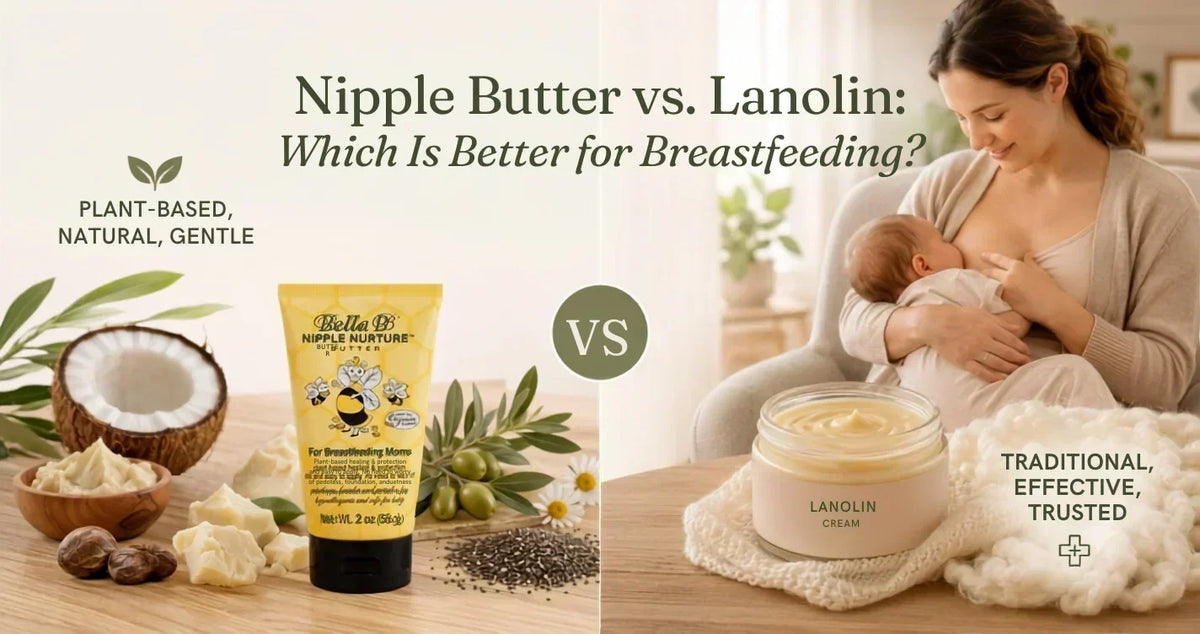
Nipple butter vs lanolin - which is better for breastfeeding? Plant-based nipple butters offer a vegan, allergy-friendly alternative to traditional lanolin, while providing similar soothing and moisturizing benefits for sore, cracked nipples.
Sore or Cracked Nipples While Breastfeeding? You're Not Doing It Wrong
If you're two weeks into breastfeeding and your nipples feel like they've been through a cheese grater, you are not alone, and you have not failed at this. Sore, cracked, even bleeding nipples are one of the most common reasons new moms consider quitting breastfeeding early, and most of it comes down to latch adjustment, skin healing time, and using the wrong (or no) barrier cream in between feeds.
That's where the nipple butter vs. lanolin debate actually matters. Both are marketed as "the" solution for cracked nipples, but they're built from completely different ingredients, and that difference affects safety, comfort, and how fast you actually heal.
What's the Difference Between Nipple Butter and Lanolin?
Lanolin is a waxy substance secreted from sheep's skin and harvested from shorn wool. It's been the go-to nipple cream ingredient for years because its texture is similar to human sebum, and brands like Lansinoh built entire product lines around it.
Nipple butter is a lanolin-free alternative made from a blend of edible plant oils and butters, such as shea butter, cocoa butter, mango butter, coconut oil, or olive oil. It's thicker than a lotion, spreads easily, and is designed to sit on the skin as a protective, moisturizing barrier without any animal-derived ingredients.
On paper, they solve the same problem. In practice, they're not interchangeable, especially once you look at safety data.
If you're dealing with sore or cracked nipples while breastfeeding walks through the causes in more depth. This piece is about which product to reach for.
Is Lanolin Safe for Breastfeeding?
Yes, for most moms, but the real answer hinges on purification grade, and that's the part most comparison articles skip.
On Purification
Raw wool is treated with pesticides and insecticides to control parasites, then processed with solvents to strip those chemicals back out. In unpurified or low-grade lanolin, residue can remain. Highly purified medical-grade lanolin (HPA lanolin, the grade used in Lansinoh and Purelan) goes through additional refining specifically to remove pesticide and detergent residue and reduce free lanolin alcohols, the fraction most associated with skin reactions. If you're going to use lanolin, this is the grade to look for, not generic or unrefined lanolin.
On Allergy Risk
Women with a confirmed wool or lanolin sensitivity should avoid it regardless of purification grade. Even with purified lanolin, some women develop irritation or contact dermatitis with repeated use, especially on skin that's already cracked.
On Effectiveness: What the Clinical Literature Actually Shows
- A meta-analysis of controlled trials found lanolin performed better than routine care for nipple pain and trauma.
- A separate systematic review found two moderate-quality studies where aloe vera and purslane outperformed lanolin for healing sore nipples.
- One randomized, double-blind trial compared lanolin to a combination antibacterial/antifungal/steroid nipple ointment and found the two equally effective, with the same pain reduction, healing time, breastfeeding duration, and mastitis rates.
- Another randomized trial compared lanolin to usual care (education, warm/cool compresses, air-drying, breast shields) and found no measurable difference in nipple pain 4–7 days later.
THE HONEST TAKEAWAYPurified lanolin isn't unsafe, and it isn't ineffective. But the evidence doesn't crown it the definitive winner either; it performs comparably to several alternatives, including plant-based and non-pharmacological options, across different trials. That inconsistency is exactly why "which one is better" doesn't have a single universal answer. |
Lanolin vs. Nipple Balm: A Side-by-Side Breakdown
|
Factor |
Lanolin |
Plant-Based Nipple Butter |
|
Source |
Sheep's wool (animal-derived) |
Shea, cocoa, mango butter, plant oils |
|
Vegan-friendly |
No |
Yes |
|
Allergy risk |
Low with purified (HPA) lanolin; avoid if confirmed wool/lanolin sensitivity |
Generally low, but check for fragrance and specific plant allergens |
|
Wipe off before feeding? |
Not required if purified/medical-grade |
Generally not required, if food-grade |
|
Texture |
Thick, sticky, can stain clothing |
Thick but typically smoother, less sticky |
|
Clinical performance |
Beat routine care in one meta-analysis; equal to a medicated ointment in one RCT; no different from usual care in another |
Comparable barrier protection in product testing; no pesticide-residue question, no animal-derived ingredients |
|
Best for |
Moms who tolerate it well and want a widely studied, medical-grade option |
Vegan moms, sensitive skin, wool allergy, prevention-stage daily use |
Is Nipple Butter Better Than Lanolin?
For most breastfeeding moms, yes, for practical and preference reasons, though not because lanolin is clinically "bad." Here's the honest reasoning:
- No animal-derived ingredients. If you're vegan or simply prefer not to put a sheep's wool byproduct on the part of your body your baby is feeding from, a vegan nipple cream removes that question entirely.
- No pesticide-residue conversation to have. With a clean, food-grade nipple butter, you're not relying on "residue within accepted limits" as your safety bar; you skip the question altogether.
- Better fit for prevention, not just crisis treatment. Nipple butter tends to work well as a daily comfort layer from day one, whereas lanolin is more commonly reached for once cracking has already started.
- Multi-use. A good nipple butter, like Bella B's Nipple Nurture Butter, doubles as a lip, cuticle, or dry-elbow balm. Lanolin products are typically marketed for nipples only.
Where lanolin can still make sense: if you've used purified, medical-grade lanolin before without any reaction and it worked for you, there's no clinical reason to switch mid-journey. This isn't a case where one option is universally superior; it's a case where your specific situation (vegan preference vs. no preference, sensitive skin vs. no history of reactions, prevention vs. treating existing damage) should drive the choice.
How Much Should You Actually Apply?
APPLICATION TIPMost moms use way more than they need, which wastes product and can leave nipples feeling greasy or sticky against clothing. The standard guidance: soften a pea-sized amount between your fingers first, then apply to the entire nipple and areola area. For lanolin, apply after feeding rather than before, so it has time to absorb into the skin instead of transferring straight to your baby's mouth. Nipple butter follows the same rule of thumb: a little goes further than it looks like it should, and reapplying after every feed works better than piling on one thick layer a few times a day. |
Best Non-Lanolin Nipple Cream Options: What to Look For
If you're searching for the best non-lanolin nipple cream, don't just grab whatever's marketed as "natural"; check the label for these things:
|
✔ Food-grade ingredients. If it doesn't need to be wiped off before nursing, it should be safe for your baby to ingest in small amounts. |
|
✔ Short ingredient list. Shea butter, cocoa butter, mango butter, coconut oil, olive oil; these are the ingredients doing the actual healing work. |
|
✔ No added fragrance. Scented products are more likely to irritate sensitive nipple skin and can also make babies reject the breast. |
|
✔ Third-party or dermatologist testing, where available. |
Non-Lanolin Nipple Cream for Sensitive Skin
If your nipples are already cracked, bleeding, or reacting to anything you put on them, sensitivity is the priority, not just ingredient trends. Look specifically for non-lanolin nipple cream for sensitive skin formulas that skip:
- Alcohol (drying, worsens cracking)
- Added fragrance or essential oils
- Vitamin E creams in high concentrations (can be risky for the baby if not diluted properly)
- Petroleum-based products (they block airflow and can clog Montgomery glands)
- Parabens and synthetic preservatives
A minimal, plant-based nipple butter formulated specifically for nursing checks all of these boxes without you needing to decode an ingredient label mid-feed at 3 am.
What Can I Use Instead of Lanolin for Breastfeeding?
Beyond commercial nipple butters, moms searching for what they can use instead of lanolin for breastfeeding commonly land on:
- Pure olive oil was used as a comparison arm in several nipple-healing trials, with mixed but generally favorable results.
- Coconut oil has natural antimicrobial properties that lanolin doesn't have.
- Expressed breast milk studied directly against lanolin in clinical trials, with results varying by study; it's also free and always on hand.
- A formulated plant-based nipple butter combines several of the above into one product designed specifically for this use case, rather than making you DIY it.
The DIY oil route works for some moms, but a purpose-built nipple butter is formulated for texture, staying power, and barrier protection in a way that a single oil often isn't.
The Bottom Line
VERDICTPurified, medical-grade lanolin isn't dangerous for most people, and the clinical picture is genuinely mixed; it's beaten routine care in some trials, matched a medicated ointment in another, and shown no advantage over usual care in a third. What it does carry is an animal-derived origin and a purification-dependent safety profile that doesn't sit right with every mom. A well-formulated, plant-based nipple cream gives you comparable barrier protection without that baggage, plus it works well as a daily preventive layer rather than just a crisis fix. If your nipples are sore, cracked, or just tender from the early weeks of nursing, a clean, food-grade lanolin-free nipple cream is the lower-friction choice for most moms, and if you've used purified lanolin before without issue, there's no clinical reason to switch just because it's not trending. Either way: get your latch checked. Nothing in the research suggests any cream, lanolin, or butter fixes a latch problem on its own. |
