
QUICK ANSWERBaby oil is usually made from either highly refined mineral oil or a blend of plant-based oils. Traditional baby oil formulas commonly use mineral oil as the main ingredient and may add fragrance or ingredients such as vitamin E. Other baby oils use oils derived from plants, seeds, or fruits, including sunflower, sesame, jojoba, grapeseed, avocado, or coconut oil. |
So, if you have been wondering what baby oil is made of, there is not one recipe hiding inside every bottle. “Baby oil” tells you what the product is designed for. The ingredient list tells you what is actually in it.
And no, despite the old joke, nobody is squeezing babies to make baby oil. We can put that mystery to bed.
If you have ever turned over a bottle and stared at words like mineral oil, Paraffinum Liquidum, or Helianthus Annuus, wondering whether you suddenly needed a chemistry degree to give your baby a massage, you are in good company.
At Bella B, we would rather make ingredient labels easier to understand than make you memorize a dictionary of cosmetic terms. So let us break it down together.
What Is Baby Oil Made From?
There are two broad types of baby oil you are most likely to find: mineral-oil-based baby oil and plant-based baby oil.
Traditional baby oil is commonly made with highly refined mineral oil. For example, Johnson's Baby Oil uses mineral oil as its base along with fragrance.
Other formulas take a different route and use plant-derived ingredients instead. Depending on the product, you may find sunflower seed oil, sesame oil, jojoba oil, grapeseed oil, avocado oil, coconut oil, or a blend of several oils.
That is why asking what kind of oil baby oil is is a bit like asking what kind of bread is in a sandwich. There is a common answer, but you still need to look at the particular sandwich in front of you. Or, in this case, the bottle sitting next to the diaper cream.
|
BELLA B TIP Flip the bottle over before you decide whether a baby oil is right for you. The front label tells you what the product wants to be called. The ingredient list tells you what you are actually buying. |
Is Baby Oil Mineral Oil?
Many baby oils are mostly mineral oil, but not every baby oil is mineral oil.
Mineral oil is an individual ingredient. Baby oil is a finished skincare product. A manufacturer can make baby oil using mineral oil, plant oils, or a combination of different ingredients.
|
Mineral Oil |
Baby Oil |
|
A specific ingredient |
A finished skincare product |
|
Usually clear and odorless |
May contain fragrance or other ingredients |
|
Derived from refined petroleum |
May be mineral-oil based or plant-oil based |
|
Used in many skincare products |
Formulated for skincare, moisture, or massage |
So, is baby oil the same as mineral oil? Not exactly. If a baby oil contains mostly mineral oil, the two may feel and behave similarly. But saying all baby oil is mineral oil ignores the many products that use different base ingredients.
Poison Control's baby oil guidance also explains that conventional baby oil commonly contains mineral oil and provides advice about keeping it safely away from young children.
Where Does Mineral Oil Come From, and How Is Baby Oil Made?
This is usually the part that makes parents raise an eyebrow. Mineral oil is derived from petroleum. Before you picture someone pouring motor oil onto your baby’s skin, though, there is an important distinction.
The mineral oil used in cosmetic products is refined and purified. It is not the same thing as crude petroleum or the lubricant sitting beside someone’s lawn mower.
For traditional baby oil, petroleum-derived mineral oil goes through processing and purification before it becomes a cosmetic ingredient. Manufacturers may then combine it with fragrance, vitamin E, or other skin-conditioning ingredients to create the finished formula.
Plant-based baby oils take a different route. Their oils come from sources such as seeds or fruits. Several oils can then be blended together to create the texture, spreadability, and glide wanted from the finished product.
Mineral oil mainly works as an occlusive. In normal-person language, that means it creates a layer over the skin that can help slow moisture loss. Think of it less like pouring more water into a cup and more like putting a lid on the cup so the water already there does not escape as quickly.
|
GOOD TO KNOW Where an ingredient starts is not the whole story. Its source, refining, formulation, concentration, and how you use the finished product all matter. That is more useful than sorting ingredients into scary and not-scary piles based on one word on the label. |
What Else Can Be in Baby Oil?
Once you start checking baby oil ingredients, you will notice that some bottles contain only a few ingredients while others look like a grocery list written in Latin. Do not let the long names scare you.
- Mineral oil
- Sunflower seed oil
- Sesame oil
- Jojoba oil
- Grapeseed oil
- Avocado oil
- Coconut oil
- Vitamin E
- Botanical ingredients
- Fragrance
- Antioxidants that help protect the formula
Some formulas are deliberately simple. Others combine several ingredients because each can play a different role in texture, skin feel, spreadability, or stability.
|
OUR SIMPLE RULE Do not judge a baby oil only by the words on the front of the bottle. Turn it around. The ingredient label is where the real story lives. |
Is Mineral Oil Safe for Babies?
Hearing the word “petroleum” can make mineral oil sound more alarming than it actually is. But instead of asking only, “Does this ingredient come from petroleum?” we would encourage you to ask: What is in the finished formula, how am I going to use it, and how does my baby’s skin respond?
The American Academy of Dermatology, for example, includes non-food-based baby oil as one option parents can use to help soften stubborn cradle-cap scales before shampooing.
If flaky scalp buildup is the issue you are trying to tackle, you can also use our Bee Gone Cradle Cap Baby Shampoo as part of your baby’s scalp-care routine. We formulate it with ingredients including shea butter, aloe, oatmeal, vitamin E, and tea tree oil for a gentle, practical bath-time step.
Still, even a product designed with babies in mind may not agree with every baby’s skin. Some babies can react to fragrance or another ingredient in a finished formula, even when the base oil itself is generally well tolerated.

|
SAFETY NOTE Baby oil is made for external use. Keep bottles somewhere your baby or toddler cannot drink from them. Poison Control warns that aspiration can cause serious lung problems if baby oil is swallowed and enters the lungs. |
Are Plant-Based Baby Oils Better?
Not automatically. We work with naturally derived ingredients in many of our products, but we do not think the word natural should end the conversation. Your baby’s skin does not read marketing copy.
Plant-based oils can give you a smooth texture and comfortable glide during massage, but botanical ingredients can still cause sensitivity in some people. On the other hand, a mineral-oil-based product should not automatically be dismissed simply because mineral oil originated from petroleum.
Instead of dividing every formula into “good” and “bad,” ask yourself: Is this product designed for babies? What is actually in it? Does it contain fragrance? Is my baby’s skin already irritated? What am I using this product for?
If your baby has eczema, known allergies, broken skin, or particularly reactive skin, talk with your pediatrician or dermatologist before trying something new. And when you introduce a new product, starting with a small amount lets you see how your baby’s skin responds.
Why We Formulate Our Baby Massage Oil Differently
When we created our massage oil for newborns, we were not trying to recreate the classic mineral oil and fragrance baby oil formula.
We chose naturally derived ingredients and paired lavender and chamomile with a lightweight texture that glides easily over your hands as you massage your baby. That is useful if what you are really looking for is not simply “baby oil,” but an oil that fits naturally into an after-bath or bedtime massage routine.
Warm a small amount between your palms and use gentle strokes across your baby’s back, tummy, arms, and legs. And no, massage does not have to become a 45-minute spa treatment. Your baby already has a packed schedule of eating, sleeping, staring deeply at ceiling fans, and occasionally becoming furious because a sock exists.
For us, baby massage is not about creating another complicated routine. It is about giving you a simple way to slow things down, add gentle touch, and make bedtime or after-bath time feel a little calmer.

|
BELLA B ROUTINE TIP Keep it short and comfortable. A few quiet minutes after bath time or before bed can be enough. The goal is not a perfect routine; it is a gentle one you can actually repeat. |
Baby Oil or Baby Lotion: What Is the Difference?
Oil and lotion can both have a place in your baby’s skincare routine, but they do not necessarily do the same job. An oil gives your hands more slip, which makes it especially useful during massage. A lotion typically contains water along with moisturizing ingredients and is designed to spread easily while adding everyday moisture.
So if your goal is a gentle bedtime massage, an oil may make more sense. If your baby’s skin simply feels dry after bathing, a lightweight moisturizer may be the more practical choice.
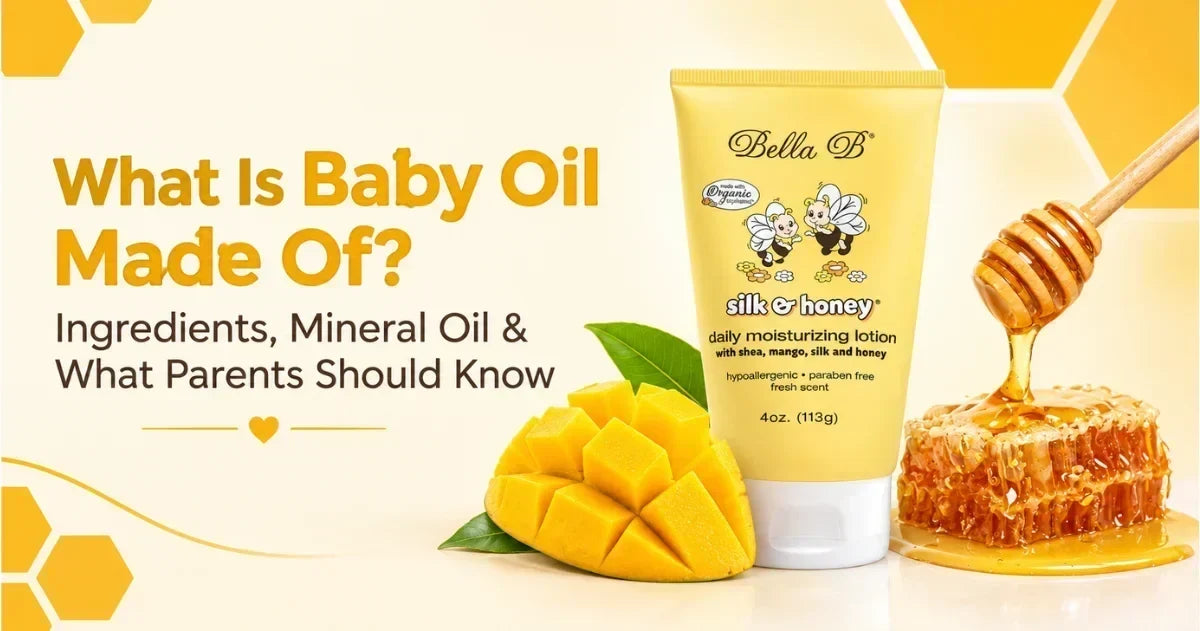
For everyday moisture, our Silk and Honey Baby Daily Moisturizing Lotion combines ingredients including shea butter, honey, organic aloe vera, jojoba oil, and other conditioning ingredients in a lightweight formula.

Silk and Honey Baby Daily Moisturizing Lotion 4 oz
BUY NOW - Silk and Honey Baby Daily Moisturizing Lotion 4 oz|
A SIMPLE BELLA B ROUTINE After bath: Pat your baby’s skin gently rather than rubbing it completely dry. |
How Should You Choose a Baby Oil?
If you are standing in front of a shelf wondering which bottle deserves a place in your baby’s routine, here is what we would look at.
- Read the full ingredient list
Find out whether the base is mineral oil, plant-derived oils, or another blend. Do not let the biggest words on the front of the packaging make the decision for you.
- Pay attention to fragrance
If your baby’s skin tends to react easily, look closely at whether the formula contains fragrance and talk with your pediatrician if you are unsure what is appropriate.
- Think about why you are buying it
Do you want an oil specifically for massage, something to use after bath time, or are you actually trying to deal with dry skin and would be better served by a lotion? The right product depends partly on the job you are asking it to do.
- Introduce new products carefully
Use a small amount at first and watch your baby’s skin. If you notice persistent redness, swelling, itching, or irritation, stop using the product.
- Keep oils away from your baby’s mouth
Skincare products designed for external use should stay external.
If you are putting together a broader bath, massage, moisture, or scalp-care routine, you can browse our Baby Care rather than trying to make one bottle solve everything.
|
BELLA B'S BOTTOM LINE The easiest way to understand what is in baby oil is to stop thinking of baby oil as one ingredient. Traditional formulas are often mineral-oil based. Other formulas use plant-derived oils and different supporting ingredients. |
