
QUICK ANSWERNo, baby shampoo is not automatically sulfate-free. Some formulas skip sulfates entirely, while others still use Sodium Laureth Sulfate (SLES) to create lather. The only reliable way to know is to check the ingredient list yourself and choose a sulfate-free baby shampoo built for delicate, developing skin. |
Are Baby Shampoos Sulfate-Free?
Not automatically, no. Labels like “gentle,” “tear-free,” or “hypoallergenic” describe how a shampoo feels, not what it's made of. A bottle can carry every one of those claims and still contain a sulfate.
This is the real question behind most searches for baby shampoo without sulfates: parents aren't chasing an ingredient trend; they're trying to find a gentle baby shampoo for sensitive skin that won't leave the scalp dry, flaky, or irritated after bath time.
Why This Question Matters More Than It Seems
Most parents don't start reading ingredient labels out of curiosity. They start after noticing something: dryness, flaking, redness, or a baby who fusses through bath time.
According to the Cosmetic Ingredient Review, an independent expert panel that evaluates cosmetic ingredient safety, sulfate-based surfactants are approved for use but are recognized to cause eye and skin irritation in some formulations. That single fact is why “sulfate-free” becomes a genuine priority once a baby's scalp starts reacting, and not just a marketing checkbox.
What Are Sulfates in Baby Shampoo?
Sulfates are surfactants: cleansing agents that lift oil, sweat, and residue off the scalp while producing foam. They work well, which is exactly the problem for a newborn. A cleanser strong enough to strip adult scalp buildup can be far more than a baby's skin needs.
Research on sodium lauryl sulfate published in the National Library of Medicine's PMC database confirms that even short exposure to sulfate surfactants measurably increases transepidermal water loss, redness, and dryness, effects that show up faster on thinner, more sensitive skin.
Sodium Lauryl Sulfate vs. Sodium Laureth Sulfate: What's the Real Difference?
Flip the bottle around, and the two names to watch for are:
- Sodium Lauryl Sulfate (SLS): the stronger cleanser, more likely to strip natural oils
- Sodium Laureth Sulfate (SLES): a milder, ethoxylated version, but still a sulfate ingredient
SLES is gentler than SLS, but “milder sulfate” is not the same as an SLS-free shampoo. If either name appears on the label, the product isn't sulfate-free, full stop. Beyond that one ingredient, fragrance load, pH, and how easily a formula rinses matter just as much to how a baby's scalp actually responds.
KEY NOTESLES is not the same as “sulfate-free.” If a label says “gentle” but the ingredient list shows Sodium Laureth Sulfate, it still contains a sulfate, just a milder one. |
Why Baby Skin Needs a Gentler Standard
A newborn's skin isn't a smaller version of adult skin.
A review of infant skin physiology in the National Institutes of Health's PMC repository found that infant skin has a thinner stratum corneum and epidermis than adult skin, which shortens the path for ingredients to penetrate and makes the skin barrier easier to disrupt. That barrier keeps developing for roughly two years after birth.
Practically, that means that a dandruff shampoo that an adult tolerates without a second thought can still be too harsh for an infant scalp. This is exactly why a natural cleanser designed around a baby's chemistry, not an adult's, makes a measurable difference in comfort and skin health.
How to Check If a Baby Shampoo Is Sulfate-Free
Skip the guesswork. Scan the ingredient list for:
- Sodium Lauryl Sulfate
- Sodium Laureth Sulfate
If either shows up, the shampoo isn't sulfate-free, regardless of what the front label claims. Then look at the fuller picture:
- Is it formulated specifically for delicate baby skin, or is it a general-purpose cleanser?
- Is it heavily fragranced, or fragrance-free?
- Is it positioned as a tear-free baby shampoo for daily use?
That broader view tells you more than any single front-of-bottle claim. If you want to dive deeper into what the safest shampoo for newborns is, you can read our full guide on which baby shampoo is safest.
Is Sulfate-Free Baby Shampoo Always the Better Choice?
Not automatically. A sulfate-free label is a strong starting point, especially for a baby with dry or reactive skin, but it isn't a guarantee of mildness on its own. Some sulfate-free formulas still lean heavily on fragrance or other irritants. What actually matters is the full formula and how your baby's scalp responds after washing, not one ingredient claim in isolation.
What to Look for in the Best Sulfate-Free Baby Shampoo
When parents search for the best sulfate-free baby shampoo, they're usually looking for a short, specific list:
- Mild cleansing that doesn't strip natural moisture
- Easy rinsing with minimal residue
- A tear-free, low-sting formula
- Ingredients suited to sensitive skin babies
- Light or no added fragrance
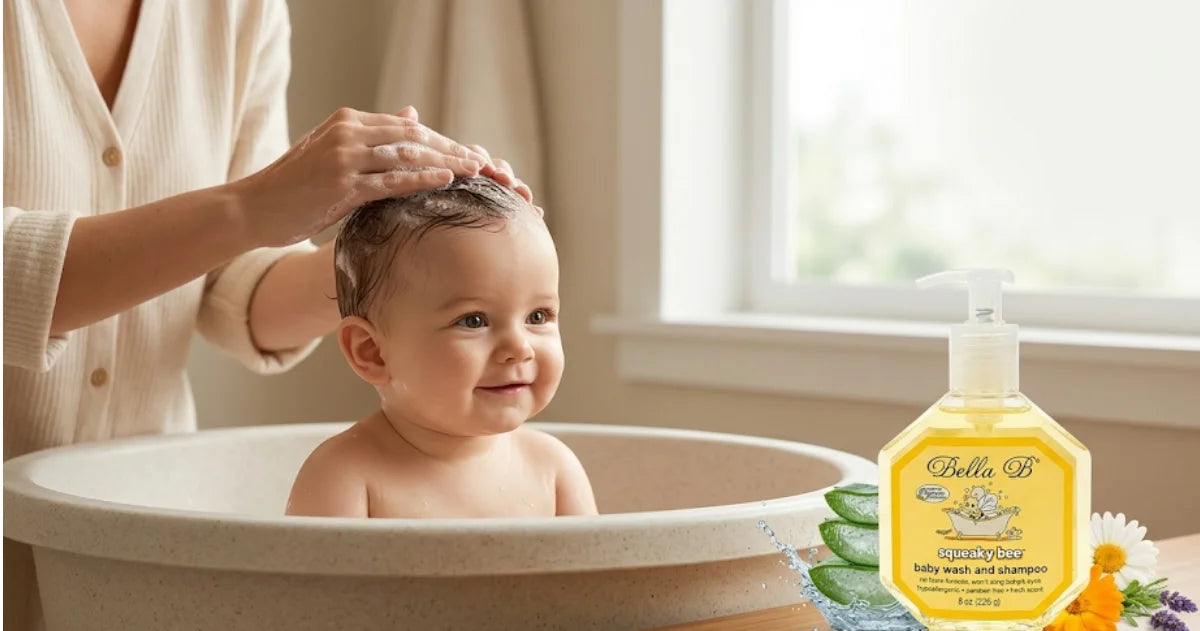
QUICK TAKEAWAYBella B Naturals' Squeaky Bee Hair and Body Wash is formulated around this exact list: a sulfate-free, tear-free daily wash for babies who just need a mild, everyday clean. |
Sulfate-Free Baby Shampoo for Dry Scalp, Dandruff, or Cradle Cap
Not every baby shampoo need is the same. Some babies do fine with a gentle everyday formula. Others are already dealing with a dry scalp shampoo situation: flaking, buildup, or cradle cap.
Cradle cap is common and, per the American Academy of Pediatrics, affects roughly 70% of three-month-olds. It's a form of seborrheic dermatitis, not a hygiene issue, and it's rarely itchy or uncomfortable for the baby, though the scales can look alarming to a new parent.
For everyday cleansing, a mild organic baby shampoo like Squeaky Bee is the right call. For visible flaking or crusting, a targeted cradle cap shampoo is designed to loosen buildup.
What About Eczema-Prone or Very Sensitive Skin?
Babies with eczema or highly reactive skin need an extra layer of caution. A fragrance-free baby shampoo with minimal ingredients reduces the number of potential triggers, and a sulfate-free, hypoallergenic shampoo lowers the odds of the cleanser itself contributing to a flare. This is a case where reading the full ingredient list matters more than any single label claim on the bottle.
When to Loop In Your Pediatrician
A shampoo can support comfort, but it can't treat every underlying skin condition. Check in with your pediatrician if your baby's scalp is:
- Very red or inflamed
- Painful to the touch
- Not improving with a gentler routine
Professional guidance rules out conditions that need more than a formula change.
QUICK CHECKLIST
|
The Bottom Line
Newborn shampoo isn't sulfate-free by default, and it doesn't need to be perfect on paper to work well for your baby. What matters is the full formula, not one ingredient claim.
Whether you land on a sulfate-free baby shampoo or not, the real test is simple: does your baby's scalp feel clean, calm, and comfortable after every wash?
