
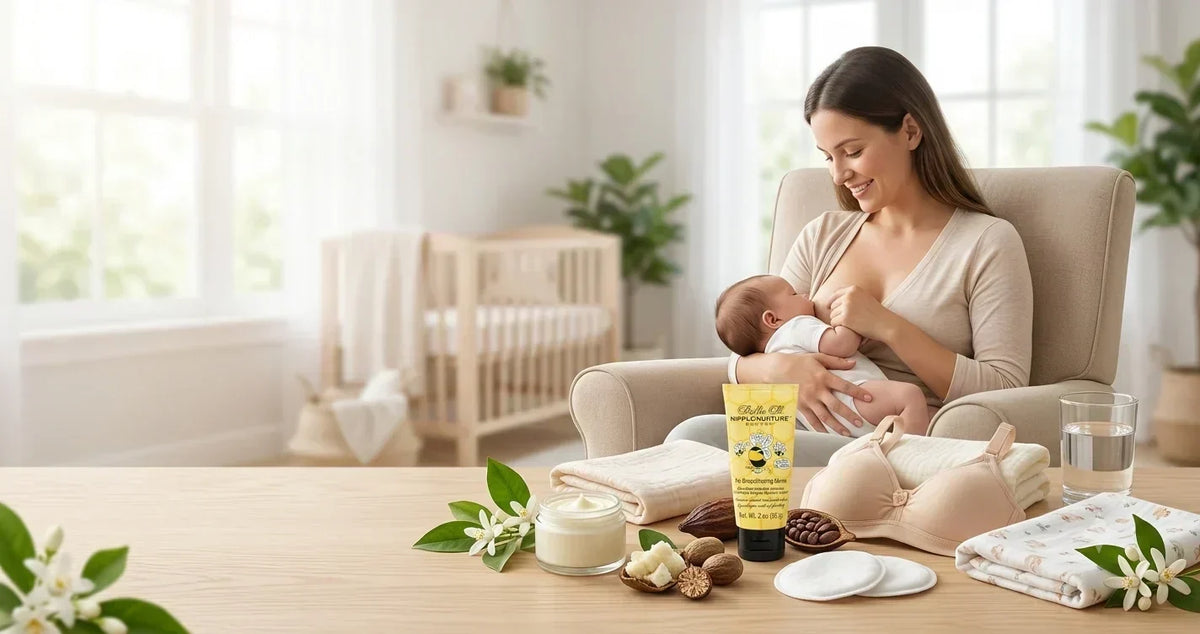
How to Choose a Clean, Plant-Based Option
If your nipples feel raw, cracked, or on fire every time your baby latches, you're not doing anything wrong, and you're definitely not alone. Sore nipples are one of the most common (and most under-talked-about) parts of the early breastfeeding weeks. The good news is that a safe nipple cream for breastfeeding can genuinely make those first few weeks more bearable, as long as you know what to look for. Bella B Naturals has specially designed the products with baby safety in mind. But first, let's talk through what actually makes a nipple cream safe, and how to tell a truly clean formula from clever marketing.
Quick Answer: Are Nipple Creams Safe for Breastfeeding?Yes, most nipple creams are safe for breastfeeding, as long as they're made from food-grade, ingestible ingredients. A safe nipple cream for breastfeeding should contain no parabens, phthalates, synthetic fragrance, mineral oil, or added preservatives, since these ingredients aren't meant to be swallowed. Plant-based options like organic shea butter, cocoa butter, and cold-pressed oils are considered gentle enough that you don't need to wipe them off before your baby nurses again. |
Is Nipple Cream Safe to Use While Breastfeeding?
Short answer: yes, for the vast majority of nursing parents. Nipple soreness in the first days and weeks is so common that lactation organizations openly recommend using a soothing balm between feeds. La Leche League International notes that applying your own expressed milk or a nipple-safe emollient can be genuinely soothing while your nipples heal.
That said, "safe" isn't automatic just because a product is sold for nursing mothers. Safety comes down to the ingredient list. A nipple cream is considered safe for breastfeeding when it's:
- Made from ingredients that are safe to swallow in small amounts
- Free of synthetic fragrance, dyes, and harsh preservatives
- Non-irritating and unlikely to trigger a skin reaction
- Easy to apply and absorb without leaving a greasy film that interferes with the latch
If your nipple pain doesn't ease up after the first couple of weeks, or if you notice cracking, bleeding, or a burning pain during and between feeds, that's worth a conversation with a lactation consultant. A nipple cream can soothe the skin, but it won't fix an underlying latch or positioning issue. La Leche League GB has a helpful breakdown of the more common (and less common) causes of nipple pain if you want to rule those out first.
Do You Have to Wash Off Nipple Cream Before Breastfeeding?
This is one of the questions we hear most, and the answer depends entirely on the formula.
If a nipple cream is made only from ingredients that are safe for your baby to ingest, like organic shea butter, cocoa butter, coconut oil, or sunflower oil, you don't have to wash it off before the next feed. That's actually one of the biggest selling points of a genuinely clean, plant-based nipple butter: it's meant to stay on.
If a product contains synthetic additives, fragrance, or preservatives you wouldn't want your baby swallowing, it should be wiped off before nursing. So when a brand markets itself as "nipple cream you don't have to wash off," check that the claim is backed by a genuinely minimal, edible ingredient list, not just a comforting phrase on the label.
Is Nipple Butter Safe for Baby to Swallow?
A well-formulated nipple butter is designed with this exact question in mind. Because babies nurse directly from the area where the cream is applied, every ingredient should be something you'd be comfortable with your baby swallowing in trace amounts.
This is why clean nipple butters usually stick to a short list of recognizable, food-based ingredients, think shea butter, cocoa butter, beeswax, or a plant-based wax alternative, and a light carrier oil. If you can't picture eating a tiny amount of an ingredient, it probably doesn't belong in something applied right where your baby feeds.
Nipple Butter vs. Lanolin: Which One Should You Choose?
This is the comparison almost every new parent eventually runs into, since lanolin has been the go-to nipple cream ingredient for decades.
Lanolin
Lanolin is a purified wax derived from sheep's wool. Many lactation resources, including La Leche League USA, have long recommended ultra-purified lanolin because it doesn't need to be removed before feeding and has a strong safety track record. A 2025 randomized controlled trial published on NCBI / PubMed Central even found that a lanolin-beeswax-olive oil blend significantly reduced nipple pain and fissures compared to a placebo cream.
But lanolin isn't the right fit for everyone:
- It's an animal-derived product, which is a dealbreaker for vegan parents or anyone avoiding wool-based ingredients.
- It can trigger allergic reactions in sensitive people. American Pregnancy Association points out that lanolin ointments can cause allergic reactions and carry a strong smell and taste, strong enough, in some cases, that babies refuse to nurse because of it.
- Sourcing and processing vary widely between brands, so "lanolin" on a label doesn't always mean the same purity level.
Plant-Based Nipple Butter
Plant-based nipple butter, by contrast, is built from botanical fats and oils rather than animal byproducts. A good organic nipple butter tends to be:
- Unscented or very lightly scented, so it won't affect the latch
- Vegan and cruelty-free, free of the allergy concerns tied to wool-derived lanolin
- Just as effective at softening, moisturizing, and protecting cracked or tender skin
|
At a Glance |
Lanolin |
Plant-Based Nipple Butter |
|
Source |
Sheep's wool (animal-derived) |
Botanical butters & oils |
|
Vegan-friendly |
No |
Yes |
|
Allergy risk |
Possible reaction in sensitive skin |
Generally low allergy risk |
|
Smell/taste |
Can be strong; some babies resist it |
Neutral to none |
|
Wash off before feeding? |
Not required (purified grades) |
Not required (clean formulas) |
|
Best for |
Parents are comfortable with animal-derived, medical-grade formulas |
Vegan parents & sensitive skin, plus anyone wanting a clean-label option |
Neither option is "wrong." Plenty of parents do perfectly well with pure, medical-grade lanolin. But if you want a nipple cream you don't have to wash off, without the wool-based ingredient or the allergy risk, a clean plant-based nipple butter like ours is worth trying. You can check our guide if you want to know more about the comparison of nipple butter vs lanolin.
What Ingredients to Avoid in Nipple Cream
Reading a nipple cream label is a bit like reading a food label; if you wouldn't eat it, think twice about applying it somewhere your baby's mouth will touch minutes later. Ingredients worth avoiding include:
|
Ingredient |
Why Avoid It |
|
Parabens |
Preservatives that mimic estrogen in the body. The FDA notes current research hasn't shown parabens to be harmful at the low levels used in cosmetics, but many parents avoid them out of caution for a product used this close to a baby's mouth. |
|
Phthalates |
Often hidden inside "fragrance" on an ingredient list. The FDA's phthalate safety page explains that fragrance ingredients don't have to be individually listed, so you can't always tell if phthalates are present. |
|
Synthetic fragrance / "parfum" |
Can irritate sensitive nipple skin and may affect how your baby takes to your breast. |
|
Mineral oil & petrolatum |
Petroleum byproducts sit on the skin rather than absorbing into it. |
|
PEG compounds & synthetic emulsifiers |
Added mainly for texture, not for skin benefit. |
|
Added dyes or colorants |
Unnecessary for a product this simple. |
The Environmental Working Group maintains an ongoing list of ingredients of concern across personal care products, which is a useful reference if you want to double-check a specific brand.
How to Choose the Best Organic Nipple Cream for Sensitive Skin
With so many "natural" and "organic" labels on shelves, here's a simple checklist for finding a nipple cream that actually earns those words:
Check for a short ingredient list. Five to eight recognizable ingredients are a good sign; twenty unpronounceable ones are not.
Look for organic, cold-pressed, or unrefined oils and butters. These retain more of their natural fatty acids, which help skin heal.
Confirm it's fragrance-free or naturally scented. Essential oils in high concentrations can still irritate sensitive nipples, so "unscented" is often the safest bet.
Make sure it doesn't need to be washed off. If a brand advertises this, the ingredient list should back it up.
Check third-party certifications (USDA Organic, cruelty-free, dermatologist-tested) rather than taking marketing claims at face value.
Patch test first, especially if you have a history of sensitive or reactive skin.
The best organic nipple cream for sensitive skin should feel almost boring in its simplicity; that's the point. Our formula was built around exactly this checklist, using organic shea butter and plant oils with nothing synthetic added.
How to Use Nipple Cream for the Best Results
- Apply a small, pea-sized amount after each feeding or pumping session, once your nipples have air-dried.
- Gently pat it in rather than rubbing, especially if the skin is cracked.
- If you're using a genuinely clean, plant-based nipple butter, there's no need to wipe it off before the next feed.
- Keep applying for a few days after soreness improves, since the skin barrier takes a little longer to fully repair than the pain does to fade.
- If pain, cracking, or bleeding continues past two weeks, loop in a lactation consultant; cream alone can't fix a latch issue.
The Bottom Line
Sore nipples are a normal, temporary part of many breastfeeding journeys, but the cream you reach for doesn't have to be a mystery of unpronounceable ingredients. A safe nipple cream for breastfeeding should be simple enough to trust completely: something you'd be just as comfortable with your baby tasting as you are with it soothing your skin. If you're ready to make the switch to a clean, plant-based option that you don't have to wash off before feeding, try our organic nipple butter and give your skin and your baby something gentler.
