
FEATURED ANSWER
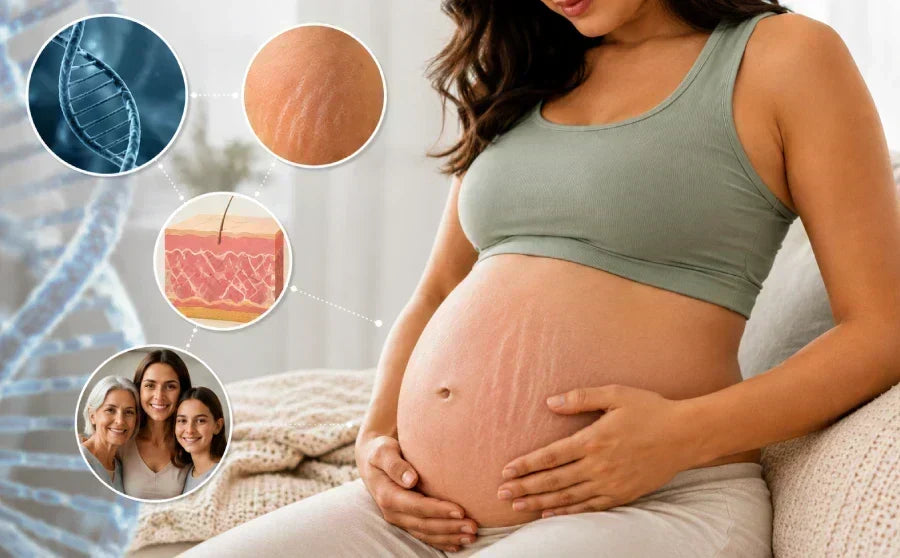
Yes, stretch marks can be genetic, including stretch marks that develop during pregnancy. If your mom, sister, or other close relatives developed pregnancy stretch marks, you may have a higher chance of getting them too. Your genes can influence skin elasticity, collagen structure, and how well your skin handles rapid stretching.
But genetics is only part of the picture. Pregnancy hormones, how quickly your body changes, your natural skin elasticity, and other individual factors can all affect whether stretch marks appear and how noticeable they become.
Your Mom Had Stretch Marks. Does That Mean You Will Too?
Maybe you've already had this conversation with your mom. You mention stretch marks, and she immediately tells you she had them across her belly, hips, or thighs when she was pregnant with you. Then you look at your own skin and wonder whether the same thing is waiting for you.
Or maybe your family experience is completely different. Your mom barely had any stretch marks, but somewhere in your second or third trimester, you start noticing thin pink or reddish lines around your belly and think, Why me?
That is usually what people are really asking when they search for “are stretch marks genetic”. They want to know whether family history decides what happens to their skin or whether there are other factors involved.
The answer is reassuringly less fixed than that. Family history can tell you something about your risk, but it does not give you an exact prediction of what your pregnancy skin will look like.
Bella B Naturals creates pregnancy-safe skincare for this stage of life, when your skin may feel tighter, drier, itchier, or simply different from what you're used to. Our stretch mark creams and belly care products are designed to help keep stretching skin moisturized and comfortable throughout pregnancy.
Why Do Some Women Get Stretch Marks and Others Don't?
This is where pregnancy can feel unfair.
Maybe your best friend went through two pregnancies with barely any visible marks, while yours started appearing around week 28. You might even be using the same belly butter she recommended and still seeing a completely different result.
The reason is that stretch mark risk is not controlled by one thing.
Pregnancy stretch marks, also called striae gravidarum, develop when the deeper layers of the skin are stretched and the supportive structures within the skin change.
Collagen helps give your skin strength and structure. Elastin gives it flexibility and allows it to stretch. The way those fibers are built and how your skin responds to rapid expansion differs from person to person, and genetics can influence some of those differences.
Pregnancy then adds more variables. Your belly grows, your breasts and hips may change, hormones fluctuate, and your skin may suddenly feel much drier or more sensitive than it did before pregnancy.
That is why two women can have very different experiences even when their pregnancies seem similar from the outside.
Are Pregnancy Stretch Marks Genetic?
Yes, there is a real genetic component.
Researchers have studied genetic differences associated with stretch marks, including variations near the ELN gene, which is involved in producing elastin.
Elastin is one of the proteins that helps your skin stretch and move. Collagen provides much of the structural support around it. Differences in these systems can influence how well skin tolerates rapid stretching.
That does not mean there is one simple “stretch mark gene.”
It is more useful to think of your skin as arriving at pregnancy with its own natural starting point. Some people may naturally have more resilient connective tissue or better skin elasticity, while others may be more prone to visible marks when the skin changes quickly.
So when people talk about hereditary stretch marks, they are really talking about a combination of inherited characteristics rather than a single genetic switch.
What Does Family History Actually Mean for Your Risk?
If your mom, sisters, or other close relatives developed pregnancy stretch marks, your own likelihood may be higher. But family history should be treated as a clue, not a forecast.
You have not inherited their exact pregnancy. Your body may change at a different rate, your baby may be a different size, your weight gain may happen differently, and your hormones and skin condition are not identical.
Even sisters can have very different pregnancies and very different skin changes.
So if stretch marks run in your family, the useful takeaway is simply that your skin may deserve a little more attention as your pregnancy progresses. It is not a reason to assume that your outcome has already been decided.
If you're early in pregnancy and wondering when skin care should become part of your routine, our guide on when to start using stretch mark cream during pregnancy explains that in more detail.
What Else Increases Stretch Mark Risk During Pregnancy?
Genetics matters, but it does not work alone. Several other things can influence how your skin responds during pregnancy.
|
What can influence stretch mark risk? |
What it means |
|
How quickly your body changes |
Rapid stretching puts more pressure on the skin. |
|
Natural skin elasticity |
Genetics, collagen, elastin, age, and skin condition can all play a role. |
|
Pregnancy hormones |
Skin may feel more sensitive, dry, oily, itchy, or reactive. |
|
Skin dryness and comfort |
Dry skin can make stretching skin feel more uncomfortable. |
How Quickly Your Body Changes
Stretch marks are strongly connected with rapid stretching.
You may notice very little for months and then suddenly see several new marks as your belly begins growing faster later in pregnancy. Similar changes can happen around the hips, thighs, breasts, and lower back.
This does not mean something is wrong. It simply means your skin is being asked to adapt quickly.
Your Natural Skin Elasticity
Some skin naturally stretches more easily than others.
Genetics, collagen structure, elastin, age, and overall skin condition can all play a role. You cannot really measure skin elasticity at home, but you may notice changes in how your skin feels.
For example, your belly may suddenly feel tighter after a shower, or the skin around your hips may become drier than usual. These changes do not automatically mean stretch marks are coming, but they can tell you that your skin is under more pressure than before.
Pregnancy Hormones
Pregnancy hormones can affect the skin and connective tissue too.
You may find that your skin becomes more sensitive, dry, oily, itchy, or reactive to products you used without a problem before pregnancy.
These pregnancy skin changes are sometimes subtle. You may simply notice that your belly feels uncomfortable by the end of the day or that your usual body lotion no longer feels rich enough.
Skin Dryness and Comfort
Dry skin does not directly create stretch marks, but it can make stretching skin feel much more uncomfortable.
Keeping your skin moisturized can help support the skin barrier and reduce the tight, itchy feeling that often comes with rapid stretching.
That is a much more realistic way to think about pregnancy skin care than expecting a moisturizer to completely control whether stretch marks develop.
Can You Prevent Stretch Marks If They're Genetic?
There is no guaranteed way to prevent pregnancy stretch marks, especially if you already have a strong genetic tendency toward them.
That does not mean caring for your skin is pointless.
Pregnancy can put your skin under months of physical change. Keeping it moisturized can help reduce dryness, tightness, and discomfort while your body grows.
If stretch marks are common in your family, you do not need to wait until the first mark appears before paying attention to your skin. Starting a simple moisturizing routine while your belly is still changing gradually can be easier than waiting until the skin already feels tight or itchy.
The important word here is support, not control.
You are supporting your skin through change, not trying to override your DNA.
What Should Pregnancy Stretch Mark Skincare Actually Do?
Pregnancy skincare does not need to be complicated.
For most people, the first question should be whether the product helps keep stretching skin comfortable enough that you will actually use it consistently.
Ingredients such as cocoa butter, shea butter, plant-based oils, aloe vera, and vitamin E can help support moisture and soften dry skin.
Texture matters too.
If a product feels sticky, takes forever to absorb, or makes getting dressed annoying, there is a good chance it will slowly disappear from your routine.
A product that fits naturally into your day is much easier to use consistently. Maybe that means applying belly butter after your evening shower or keeping your moisturizer next to your bed because that is when your skin tends to feel driest.
Pregnancy skincare should make your routine easier, not give you another job.
What If Your Skin Is Already Tight or Itchy?
Sometimes you do not think much about pregnancy skincare until your belly suddenly starts demanding attention.
You get out of the shower, and the skin feels stretched. By the evening, you notice yourself scratching the sides of your belly or around your hips without even thinking about it.
Dryness and stretching can both contribute to that feeling.
At that point, focus less on whether you are “preventing stretch marks” and more on getting your skin comfortable again. Use a rich moisturizer or belly butter on the areas that feel dry, tight, or itchy, and reapply if your skin needs it later in the day.
If itching becomes intense, persistent, widespread, or feels unusual, it is always worth discussing it with your healthcare provider rather than assuming it is simply normal skin stretching.
What If You're Doing Everything Right and Still Get Stretch Marks?
This is the part that deserves to be said clearly.
You can drink plenty of water, eat well, moisturize regularly, and start caring for your skin early and still develop pregnancy stretch marks.
Meanwhile, someone you know may barely remember to use body lotion and come through pregnancy with very few visible marks.
That can feel frustrating, but it is also a reminder that stretch marks are not a report card on how well you cared for yourself.
Genetics, collagen structure, elastin, hormones, skin elasticity, and how quickly your body changes are all part of a much bigger picture.
Skincare can support your skin. It cannot control every part of that picture.
If you'd like a more realistic look at what topical products can and cannot do, read: Does stretch mark cream work during pregnancy?.
The Bottom Line
So, are stretch marks genetic? Yes, partly.
Your DNA can influence skin elasticity, collagen and elastin structure, and your overall tendency to develop stretch marks. A family history of pregnancy stretch marks can therefore increase your likelihood of developing them too.
But your skin is responding to your pregnancy, not your mother's, sister's, or friend's.
Pay attention to how your skin feels as your body changes. Keep it moisturized when it feels dry or tight, choose pregnancy-safe products that are easy to use consistently, and keep your expectations realistic.
The goal is not perfectly unchanged skin. It is keeping your skin supported and comfortable through a period when your body is changing very quickly.
