
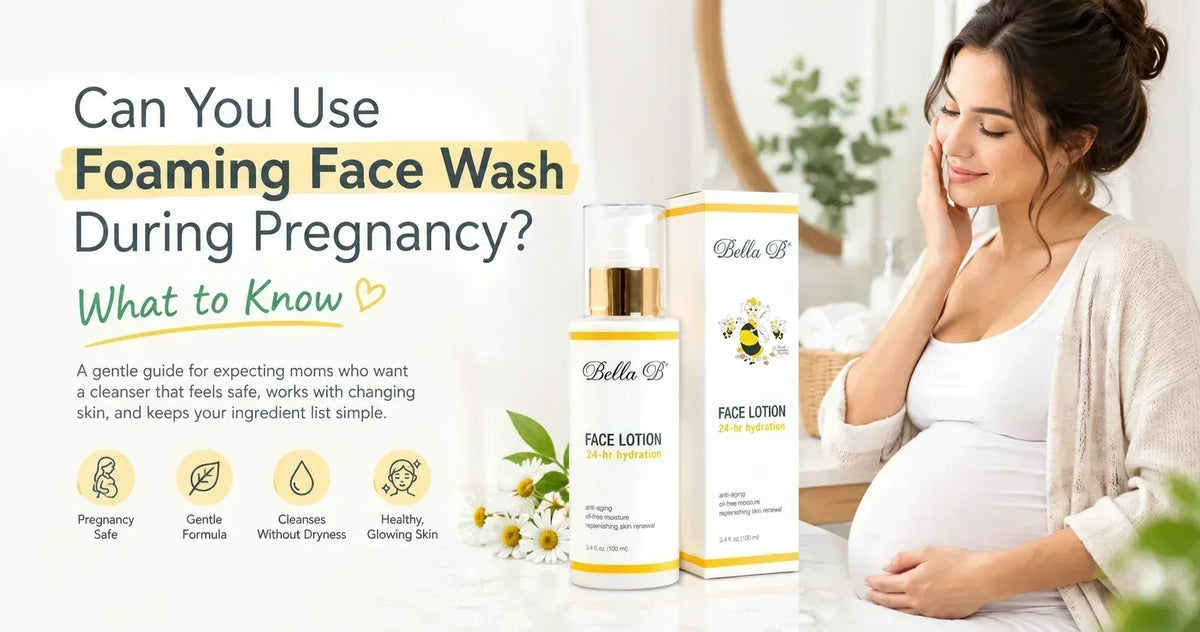
A practical guide for expecting moms who want a cleanser that feels gentle, works with changing skin, and does not turn ingredient labels into a chemistry exam.
QUICK ANSWERYes, you can generally use a foaming face wash during pregnancy. The foam itself is not what determines whether a cleanser is suitable. What matters more is the full formula, the active ingredients it contains, and how your skin feels after you rinse. |
Look for a mild cleanser that removes oil, sunscreen, makeup, and daily buildup without leaving your face tight, dry, or irritated. If you use medicated acne products or stronger actives, check the specific ingredients with your OB-GYN or dermatologist.
If you prefer a light foaming texture, Bella B Foaming Face Wash is formulated for pregnancy and sensitive, acne-prone skin without salicylic acid, benzoyl peroxide, or alpha hydroxy acids.


Why Your Normal Face Wash May Suddenly Feel Different
Pregnancy can change how your skin behaves. Someone who usually has oily skin may suddenly notice dry cheeks. Someone who rarely breaks out may start getting pimples along the chin or jaw. A cleanser you have used for years may suddenly leave your face feeling uncomfortable.
Hormonal changes during pregnancy can contribute to acne and other skin changes, according to the American College of Obstetricians and Gynecologists (ACOG).
That is why choosing a face wash for pregnant women is not only about finding a product with the right label. You also need to look at what your skin needs now.
|
SIMPLE RULE If your usual cleanser still feels comfortable and its ingredients fit your pregnancy routine, you may not need to replace it. If it suddenly stings, dries you out, or makes redness worse, that is a useful reason to reconsider it. |
Does the Foam Matter?
Not as much as people often think.
A cleanser can foam and still be mild. Another cleanser can barely lather and still irritate your skin. Foam is created by cleansing agents called surfactants. Different formulas use different types and amounts, so you cannot judge how gentle a cleanser is by the size of the bubbles.
Instead, pay attention to what happens after you rinse. Your skin should feel clean, but it should not feel painfully tight, rough, or uncomfortable. You also should not need to race for moisturizer because your face suddenly feels stripped.
|
FIVE-MINUTE CHECK Wash, rinse, wait a few minutes. If your skin feels clean and comfortable, the cleanser is probably doing its job. Persistent tightness, stinging, or flaking is a better warning sign than foam itself. |
Which Face Wash Ingredients Should You Check During Pregnancy?
You do not need to memorize an entire cosmetic ingredient dictionary. Start with the ingredients most likely to matter.
|
Ingredient |
What to do |
Why it matters |
|
Retinoids / retinol |
Avoid |
Topical retinoids and OTC retinol products are generally avoided during pregnancy. Check acne and anti-aging products carefully. |
|
Hydroquinone |
Avoid |
This skin-lightening ingredient is generally avoided during pregnancy. |
|
Salicylic acid |
Review use |
ACOG lists topical salicylic acid among OTC acne ingredients that can be used during pregnancy. Strength and frequency still matter. |
|
Benzoyl peroxide |
Review use |
ACOG also lists topical benzoyl peroxide among OTC options for pregnancy acne. Ask your clinician if you use stronger or multiple acne treatments. |
|
Fragrance |
Watch tolerance |
It is not automatically a pregnancy safety issue, but newly reactive skin may find fragranced formulas irritating. |
The American Academy of Dermatology (AAD) also recommends avoiding retinoids during pregnancy, including over-the-counter retinol products.
If you are checking several products at once, Bella B's guide to pregnancy-safe skincare ingredients goes deeper into what can usually stay, what is generally avoided, and which stronger actives deserve individual review.
|
DO NOT JUDGE BY MARKETING WORDS “Natural,” “clean,” and “pregnancy-friendly” are not substitutes for the ingredient list. Look at the actual formula, how the product is used, and how your skin responds. |
Can You Use Foaming Face Wash While Pregnant If You Have Acne?
Yes, but keep your expectations realistic.
A foaming cleanser can remove excess oil, sweat, sunscreen, and makeup. That can be useful if pregnancy has made your skin oilier or more breakout-prone. What it cannot do is control every hormonal breakout by itself.
ACOG recommends washing acne-prone skin twice a day with a mild cleanser and lukewarm water. Scrubbing aggressively or washing your face repeatedly throughout the day can irritate skin rather than improve acne.
A cleanser has a fairly simple job: clean your skin without creating another problem. It does not need to fight your entire hormonal system before breakfast.
|
WHEN CLEANSER IS NOT ENOUGH If your acne becomes painful, cystic, widespread, or starts leaving scars, speak with your dermatologist or OB-GYN instead of simply buying a stronger face wash. |
How Do You Know If Your Foaming Cleanser Is Too Harsh?
Your skin usually tells you. After cleansing, watch for:
- persistent tightness
- burning or stinging
- increased redness
- flaking around the nose or mouth
- rough patches or itching
- dryness that appears soon after washing
Occasional dryness does not automatically mean your cleanser is the cause, but a pattern matters. If your face feels uncomfortable every time you wash it, try using the cleanser less often or switch to a milder formula.
If you no longer enjoy a foaming texture, Bella B Pregnancy Safe Hydrating Face Wash is a more hydration-focused option designed for sensitive skin.
Foaming or Hydrating Cleanser: Which One Should You Choose?
Choose based on what you are actually noticing in the mirror and after washing.
|
A foaming cleanser may suit you if… · your skin feels oily by midday · you wear heavier sunscreen or makeup · you like a fresh, quick-rinsing texture |
A hydrating cleanser may suit you if… · your cheeks feel tight or flaky · cleansing has started to sting · pregnancy has made your skin unusually dry or reactive |
Combination skin can sit somewhere in between. You might have an oily forehead but dry cheeks, especially during pregnancy. You do not have to force yourself into one skin-type box. Use the gentlest product that still cleans your skin well.
How Often Should You Wash Your Face During Pregnancy?
For many people, twice a day is enough. Wash in the morning if you wake up oily or prefer starting with freshly cleansed skin. In the evening, cleansing removes sunscreen, makeup, sweat, oil, and whatever else your face collected during the day.
- Use lukewarm rather than very hot water.
- Massage cleanser gently with your fingertips instead of scrubbing.
- Rinse thoroughly and pat dry.
- If twice-daily cleansing leaves you dry, try a lighter morning routine and a full cleanse at night.
|
BELLA B TIP Your routine can change when your skin does. Pregnancy skincare does not need rigid rules or extra steps that are not helping you. |
What Should You Use After Cleansing?
You do not need a complicated routine. If your skin feels dry after washing, follow with moisturizer. Bella B Pregnancy Safe Face Lotion is a lightweight option made for sensitive skin.
Toner is optional. If you already like using one, choose something that does not leave your skin feeling stripped. Bella B Pregnancy Safe Face Toner is fragrance-free and designed to add light hydration after cleansing.
Then use daytime sun protection. That is enough for plenty of people. Pregnancy is not a requirement to suddenly build a seven-step skincare routine.


Do You Need to Replace Your Face Wash When You Become Pregnant?
Not automatically.
This is where pregnancy skincare advice can become unnecessarily stressful. A positive pregnancy test does not mean every bottle in your bathroom has suddenly become unusable. Check the ingredient list first.
If your current cleanser does not contain an ingredient you need to avoid, feels comfortable on your skin, and still does its job, you may be able to continue using it.
Consider changing it if:
- it contains a retinoid or another ingredient your healthcare provider has advised you to stop
- your skin has become more sensitive to it
- it leaves you unusually dry or irritated
- you are using a medicated cleanser and are unsure whether the active ingredient fits your pregnancy routine
If you are reviewing more than just your cleanser, the Bella B Pregnancy Safe Skincare collection brings together face and body products intended for pregnancy. Start with the product that is actually causing a problem or contains an ingredient you need to reconsider.
The Bottom Line
|
WHAT TO REMEMBER You can generally use foaming face wash during pregnancy. Do not judge a cleanser by its bubbles. Check the formula, pay attention to active ingredients, and notice how your face feels after washing. |
If your cleanser still works well, you may not need to change it. If pregnancy has made your skin oilier, drier, more sensitive, or more acne-prone, choose a cleanser for the skin you have now rather than the skin you had before pregnancy.
