
QUICK ANSWERIf you have sensitive skin, choose a neck firming cream that gives your skin enough moisture without loading it with ingredients you already know cause irritation. Look for a comfortable texture, realistic claims, and ingredients such as shea butter, glycerin, hyaluronic acid, or ceramides. Retinol and peptides can be useful, but only if your skin actually tolerates them. |
Maybe you first noticed it in the mirror under brighter light. Your neck looked a little drier than usual, or the fine lines seemed more obvious after your sunscreen had settled in.
Sometimes it's not even a dramatic change. The skin just starts feeling a little less smooth, a little more papery, or slightly tighter than the skin on your face.
So you start looking at neck creams, and suddenly every product is promising lifting, tightening, collagen support, or firmer-looking skin. If your skin is sensitive, though, your first question is probably much simpler: Will this actually help, or will my neck end up itchy and irritated?
That's where I'd start.
I wouldn't choose a neck cream based on how strong it sounds. I'd choose it based on what your skin actually needs and what you can realistically use without dreading the next application.
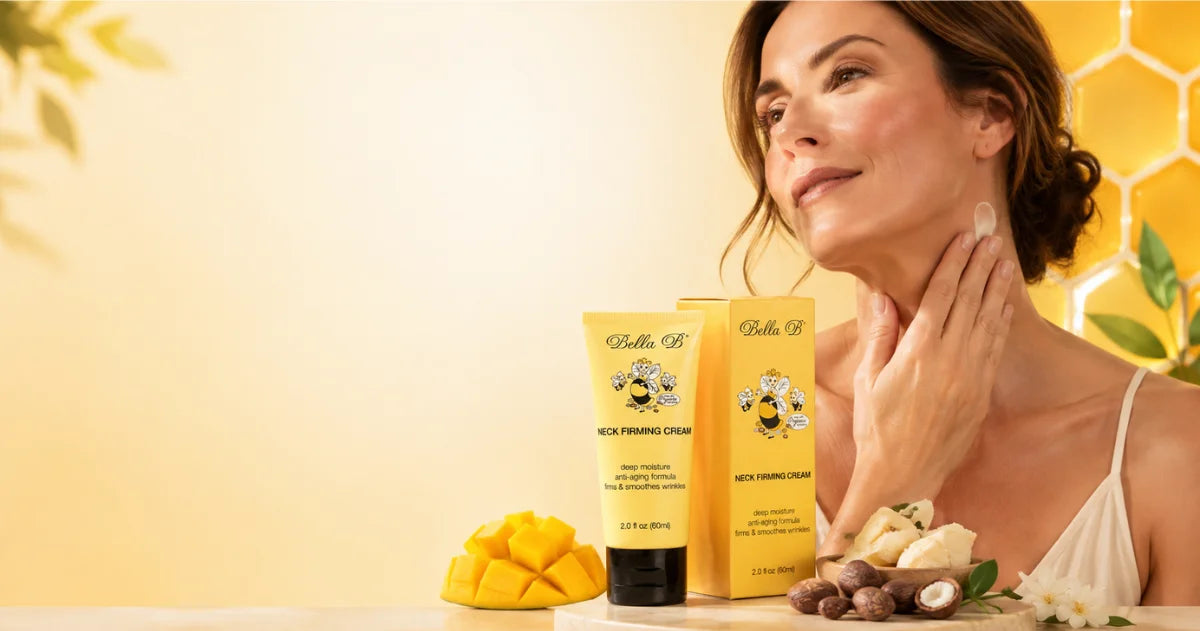
Bella B's Neck Firming Cream is built more around rich moisture than a long list of aggressive actives, with shea, mango, and cocoa butters alongside Rosa Damascena Flower Extract. That kind of formula makes more sense if your neck tends to feel dry, tight, or easily irritated.
And that's really the approach I'd keep in mind throughout this whole guide: your routine doesn't need to be aggressive to be useful.
Start With What Your Neck Is Actually Doing
Before you buy anything, look at what's really bothering you.
Is your neck dry? Does it feel tight after washing? Are the lines mostly noticeable when the skin is dehydrated? Or are you seeing more of that thin, slightly crinkled texture people usually describe as crepey?
Those things can look similar, but they don't always need the same kind of product.
If your neck mostly feels dry and looks a little crinkly, a good neck cream for dry skin may help more than you expect. When dry skin gets enough moisture, it often looks softer and smoother, and those tiny lines can become less obvious.
If texture and fine lines are more noticeable even when your skin is well moisturized, then you may want to look at additional ingredients like peptides or retinol. But if your skin is easily irritated, that choice needs to be a little more careful.
And if you're seeing genuinely loose skin, I'd keep your expectations grounded. A cream can help your skin look smoother and more supple, but it can't physically lift or remove loose skin.
That distinction saves you from spending money on promises no cream can realistically keep.
Dry and Sensitive Aren't Quite the Same Thing
This gets mixed up all the time.
Dry skin usually feels tight, rough, or flaky because it isn't holding enough moisture. Sensitive skin is more about how easily your skin reacts, so you may notice burning, redness, itching, or discomfort.
You can absolutely have both, but you don't have to.
That matters because someone with dry skin may love a rich formula, while someone with sensitive skin may be more concerned about what's in the formula than how thick it is.
|
Dry Skin |
Sensitive Skin |
|
|
What's happening |
Skin isn't holding enough moisture |
Skin reacts easily to ingredients |
|
Common signs |
Tight, rough, flaky, papery texture |
Burning, redness, itching, discomfort |
|
What to prioritize |
Richer moisture: shea, cocoa butter, glycerin |
Simple formulas, no strong or fragranced actives |
|
Can overlap? |
Yes — many people have both |
Yes — many people have both |
If you have both dryness and sensitivity, I'd keep things simple. Look for a neck cream for sensitive skin that gives you enough moisture without stacking on a bunch of strong ingredients just because they sound impressive.
What I'd Look for Before Anything Else
If you handed me two neck creams and asked me which one I'd choose, I wouldn't start by counting the anti-aging ingredients.
I'd look at the moisturizing base first.
If your neck is dry or crepey, ingredients like shea butter, cocoa butter, glycerin, hyaluronic acid, ceramides, squalane, and plant oils can matter a lot more than whatever ingredient is written in bold on the front of the jar.
|
INGREDIENTS TO LOOK FOR • Shea butter, cocoa butter, mango butter • Glycerin and hyaluronic acid • Ceramides and squalane • Gentle plant oils • Fragrance-free formulas, if you're prone to irritation |
The American Academy of Dermatology recommends creams or ointments for dry skin and suggests applying moisturizer while the skin is still slightly damp.
That doesn't mean you need every moisturizing ingredient in one formula. It just means your hydrating neck cream should actually leave your skin feeling hydrated.
If you put it on and your neck feels tight again ten minutes later, that tells you something.
Bella B also talks about ingredients such as shea butter and cocoa butter when discussing dry, stretching skin. The skin concern is different, but the basic idea is still useful: richer moisturizers can help skin feel softer and more comfortable.
Do You Need Peptides or Retinol?
Maybe. But I wouldn't start there automatically.
Peptides are common in firming products because they're often used in formulas designed to support smoother, firmer-looking skin. They can be a nice addition, but I wouldn't buy a cream just because the word “peptides” is printed in large letters on the packaging.
The whole formula still matters.
Retinol is a little different because it can genuinely be useful for fine lines and texture, but it's also one of those ingredients that some sensitive skin simply doesn't enjoy.
Cleveland Clinic notes that retinol can cause dryness, itching, burning, redness, and peeling, particularly while your skin is adjusting.
And your neck may react differently from your face.
You might use retinol comfortably on your cheeks and still find that your neck gets irritated when you bring the same product lower down.
If your skin already handles retinol well, you can consider it. If it repeatedly leaves your neck flaky or uncomfortable, I wouldn't force it into your routine just because it appears on every anti-aging list.
A moisture-focused neck moisturizer can still be useful, especially if dryness is a big part of what's making your neck look older or more crepey.
Bella B also covers retinoids and moisturizers in its ingredient guide. The takeaway I'd keep is simple: stronger isn't automatically better for you.
Pay Attention to What Your Skin Has Already Told You
This is probably the most practical advice in the whole article.
If fragranced products often make your neck itchy or red, don't ignore that because a new product has beautiful packaging.
The American Academy of Dermatology recommends fragrance-free products for dry and sensitive skin.
That doesn't mean every fragranced formula will irritate every person. It just means your own history matters.
The same goes for botanical ingredients.
I like natural skincare, but “natural” doesn't automatically mean “gentle.” Plant extracts and essential oils can still bother sensitive skin.
So if you already know a certain ingredient makes your skin unhappy, I'd trust that information more than a label that says “suitable for sensitive skin.”
Your skin has already given you the review.
Texture Matters More Than People Admit
A cream can have a beautiful ingredient list and still be annoying to use.
Your neck touches your hair, clothing, collars, scarves, jewelry, and bedding. If the formula stays tacky and your hair keeps sticking to your neck, that gets old quickly.
If your neck is very dry, you might actually prefer a richer texture that feels more cushioning. If you live somewhere warm or hate that coated feeling on your skin, you may want something that absorbs more quickly.
There isn't one perfect texture for everyone.
The best moisturizer for neck care is the one that gives you enough moisture and still feels comfortable enough to use regularly.
That last part matters because you can't really judge whether a product works if you only use it three times and then abandon it because you hate how it feels.
Do You Even Need a Separate Neck Cream?
Not necessarily.
If your regular face moisturizer works well on your neck, feels comfortable, and gives you enough hydration, you can keep using it.
You don't need a separate neck product just because skincare marketing tells you that you do.
A dedicated neck cream makes more sense when your neck behaves differently from your face.
Maybe your facial moisturizer feels too light there. Maybe the actives you use on your face are too irritating when you bring them down. Maybe your neck is noticeably drier and you want something richer.
Those are good reasons to use a separate product.
Where Bella B Fits In
If your neck gets dry easily and stronger treatments tend to make it unhappy, this is where a richer cream starts making more sense.
Bella B's Neck Firming Cream uses shea butter, mango butter, cocoa butter, and Rosa Damascena Flower Extract, so it leans more toward everyday moisture and comfort than a strong active treatment.
That won't be what everyone wants.
If you're specifically looking for a retinol-heavy formula or a product built around several clinical actives, this probably isn't the direction you're looking for.
But if you're tired of products that sound impressive and feel awful on your skin, this kind of formula may be closer to what you actually need.
You can also carry the same care down onto the décolletage if that area feels dry or needs more moisture too.
That's the way I'd think about it.
Not “Is this the strongest neck cream?” but “Does this match what my neck is asking for?”
|
PRODUCT PICK Bella B Neck Firming Cream — shea, mango & cocoa butters with Rosa Damascena Flower Extract. Built for everyday moisture and comfort rather than aggressive actives. |
What Can You Realistically Expect?
I'd keep expectations sensible here.
A good neck cream can help dry skin feel softer, improve the look of rough texture, make dryness-related fine lines less noticeable, and help the skin look more supple.
What it can't do is physically remove loose skin or create the kind of lifting effect you'd get from a cosmetic procedure.
That doesn't mean the product isn't working.
If your neck feels more comfortable, looks smoother, and stays better moisturized, that's still a meaningful result.
Hydration may be something you notice relatively quickly. Texture and the appearance of firmness make more sense to judge after consistent use rather than after a few applications.
I'd also pay attention to the quieter signs that a product suits you: your neck feels less tight, you stop reaching for extra moisturizer, and you actually want to keep using it. Those things matter more than chasing a dramatic overnight change.
Keep Your Routine Simple
You don't need a seven-step neck routine.
In the morning, use your moisturizer or neck cream and follow with sunscreen. At night, cleanse gently and apply your neck moisturizer cream or treatment.
If you're using retinol or another stronger active, start slowly instead of going all in from night one.
And if your skin is sensitive, patch testing is worth doing.
The American Academy of Dermatology recommends testing new skincare products before wider use.
I'd also avoid introducing several new products at once. If your skin reacts, it's much easier to figure out what caused it.
Don't Forget Your Neck When You Apply Sunscreen
This is probably the least exciting advice in this article, but it matters.
If you're worried about fine lines, texture, or visible changes in your neck, don't let your sunscreen stop at your jawline.
The AAD recommends broad-spectrum, water-resistant SPF 30 or higher.
Bring it down over your neck and exposed upper chest too.
It's not a miracle product, but it's one of those simple habits that makes your whole routine make more sense.
So, What Should You Choose?
If your neck is mainly dry, I'd start with richer moisture.
If it's sensitive, I'd pay more attention to what your skin already dislikes and keep the formula simple.
If fine lines or texture are your main concern and your skin tolerates stronger ingredients, then peptides or retinol may be worth considering.
And if your regular face moisturizer already keeps your neck comfortable, you may not need a separate product at all.
The right neck cream isn't the one with the longest ingredient list or the biggest promise on the jar. It's the one that matches what your neck actually needs and feels good enough that you'll keep using it.
