
Quick Answer
Toners safe for pregnancy are generally gentle formulas that hydrate or soothe the skin without pregnancy-restricted ingredients such as retinoids or hydroquinone. Look for ingredients such as hyaluronic acid, glycerin, niacinamide, aloe vera, and other gentle moisturizers. Some topical acids, including glycolic and salicylic acid, may be acceptable during pregnancy depending on their concentration and use, so check the label and ask your OB-GYN or dermatologist when you're unsure.
Pregnancy has a funny way of making you question things you never thought twice about before.
Coffee? Check the amount. Sushi? Check the fish. Your innocent-looking bottle of face toner? Suddenly you're standing in the bathroom at 10 p.m. reading an ingredient list like there's going to be a quiz.
If you're trying to find toners safe for pregnancy, you don't need to become a cosmetic chemist overnight. You do, however, need to know what your toner actually does, which ingredients deserve a closer look, and what your skin needs now. Pregnancy can change the way your skin behaves, so the toner you loved six months ago may not necessarily be the one your skin loves today.
If hydration and sensitive-skin support are what you're looking for, a pregnancy safe face toner can fit neatly between cleansing and moisturizing without making your routine unnecessarily complicated.
Let's make that ingredient label a lot less intimidating.

First, What Does A Face Toner Actually Do?
Modern toner is a pretty broad category.
Some toners mainly hydrate. Others soothe sensitive skin, remove the last traces of buildup after cleansing, or contain exfoliating ingredients designed to address texture, oiliness, or clogged pores.
That distinction matters when you're pregnant.
A simple hydrating toner and an aggressive exfoliating toner may both say “toner” on the bottle, but they aren't doing remotely the same job. Think of it like comparing herbal tea with a double espresso because they're both beverages.
And here's something skincare marketing doesn't always shout from the rooftops: toner is optional.
You don't need one simply because every skincare routine on your feed seems to contain seven steps. A toner earns its bathroom-counter real estate when it does something useful for your skin.
If your face feels dry or tight after cleansing, for example, a gentle pregnancy-safe face toner can add hydration and help prepare your skin for serum and moisturizer. Starting with a gentle pregnancy-safe face wash can also help you avoid stripping your skin before toner ever enters the picture.
If your skin is already happy without one, you don't have to create a problem just so another product can solve it.

How to Choose a Pregnancy-Safe Face Toner
Instead of searching for one magical word on the front of the bottle, turn it around. The ingredient list tells you far more.
When I'm looking at a pregnancy-safe facial toner, I would ask three questions:
- What is this toner supposed to do?
- Does its ingredient list fit pregnancy skincare guidance?
- Does it suit what my skin is experiencing right now?
That last question gets overlooked.
Pregnancy hormones can bring dryness, breakouts, increased sensitivity, pigmentation changes, or sometimes a strange combination of oily and dehydrated skin. The American College of Obstetricians and Gynecologists notes that pregnancy-related skin changes can include acne, dark spots, melasma, and other changes influenced by shifting hormone levels.
Your goal isn't to find the strongest toner you can safely get away with. It's to choose the gentlest formula that actually addresses your skin's needs.
Ingredients to Look for in Pregnancy-Safe Toners
Hyaluronic Acid
If pregnancy has left your skin feeling like it could drink a gallon of water, hyaluronic acid is worth looking for. It's a humectant, meaning it helps attract and retain moisture. In a toner, it can help skin feel softer and less tight after cleansing. This makes hydrating toners particularly useful when your skin feels dry or uncomfortable.
Bella B also discusses hyaluronic acid alongside other commonly used ingredients in its guide to pregnancy-safe skincare ingredients.
Glycerin
Glycerin isn't glamorous. It probably isn't starring in many dramatic TikTok skincare reveals either. But it is an excellent humectant. It helps draw water into the outer layer of the skin and is widely used in gentle moisturizers and hydrating skincare. If you're choosing a pregnancy-safe skin toner for dryness, glycerin is one of those quietly useful ingredients worth spotting on the label.
Niacinamide
Niacinamide, a form of vitamin B3, can support the skin barrier while helping with the appearance of uneven tone and oiliness. That combination can be especially helpful when pregnancy seems to have given your skin several personalities at once. You don't necessarily need a high concentration either. More isn't automatically better, particularly if your skin has become sensitive.
Aloe Vera and Gentle Plant-Based Ingredients
Aloe and soothing botanical ingredients can be useful in formulas intended to calm and replenish the skin. But here's an important distinction: natural doesn't automatically mean pregnancy-safe or irritation-free. A botanical ingredient is still an active substance, and essential oils or heavily fragranced plant extracts can irritate sensitive skin. Judge the whole formula rather than assuming a green leaf on the package has personally approved it for pregnancy.
What Toner Ingredients Should You Avoid or Check During Pregnancy?
This is where skincare advice online gets messy. Some lists throw virtually every active ingredient into a giant “NO” bucket. Others are far too casual. The better approach is to separate ingredients that should generally be avoided from those that simply require some context.
Retinoids
This is the big one. The American Academy of Dermatology recommends avoiding retinoids during pregnancy. That includes prescription retinoids as well as over-the-counter skincare containing retinol or related ingredients. So if an exfoliating or anti-aging toner contains retinol or another retinoid, put it aside during pregnancy and discuss alternatives with your healthcare provider.
Hydroquinone
Hydroquinone is another ingredient the American Academy of Dermatology recommends avoiding during pregnancy. If pigmentation or melasma has you tempted to attack every dark spot immediately, don't panic-buy the strongest brightening toner you can find. Pregnancy is a good time for a gentler strategy.
What About Salicylic Acid?
Here's where we need a little nuance. You may have heard that salicylic acid is completely off-limits during pregnancy. Current ACOG guidance lists topical salicylic acid among over-the-counter ingredients that can be used during pregnancy.
The American Academy of Dermatology advises using higher-dose salicylic acid, above 2%, sparingly during pregnancy. So don't automatically panic because you spotted the words “salicylic acid.” Look at the concentration, how frequently you're using the product, and ask your OB-GYN or dermatologist if you're uncertain.
And Glycolic Acid?
ACOG also lists glycolic acid among over-the-counter ingredients that can be used during pregnancy. Still, that doesn't mean your newly sensitive skin wants an exfoliating acid every night. Pregnancy-safe and irritation-proof are two different things. If your skin has become reactive, a straightforward hydrating toner may be a much better roommate for the next few months than an ambitious exfoliating formula.
Don't Forget Fragrance and Alcohol
These ingredients aren't automatically pregnancy hazards, but they can matter for a different reason: comfort. Pregnancy can make skin more sensitive, and some people also become unusually sensitive to smells. That gorgeous floral toner you once adored may suddenly smell like somebody emptied a perfume counter into your bathroom.
If you're experiencing sensitivity, dryness, or nausea triggered by fragrance, a fragrance-free toner can make your routine much easier to live with. Likewise, heavily astringent, high-alcohol formulas can leave already-dry skin feeling tight or uncomfortable.
You're trying to support your skin here, not win an argument with it.
Choose Your Toner Based on What Your Skin Is Doing
Here’s an easier way to shop. Use the table below as a quick label-reading shortcut.
|
If your skin feels... |
Look for... |
Be careful with... |
|
Dry or tight |
Hyaluronic acid, glycerin, gentle hydrating ingredients |
Strong astringents and over-exfoliation |
|
Sensitive or reactive |
Simple, fragrance-free formulas |
Fragrance and multiple strong actives |
|
Oily or breakout-prone |
Niacinamide or pregnancy-compatible acne ingredients |
Throwing several acids into one routine |
|
Uneven or dull |
Gentle brightening and hydrating ingredients |
Retinoids and hydroquinone |
|
Comfortable already |
A simple hydrating toner, or no toner at all |
Adding products just because they're trending |
Notice something? The answer isn't “buy the toner with the longest ingredient list.” Pregnancy skincare often works better when you simplify.
Where Bella B Face Toner Fits Into a Pregnancy Routine
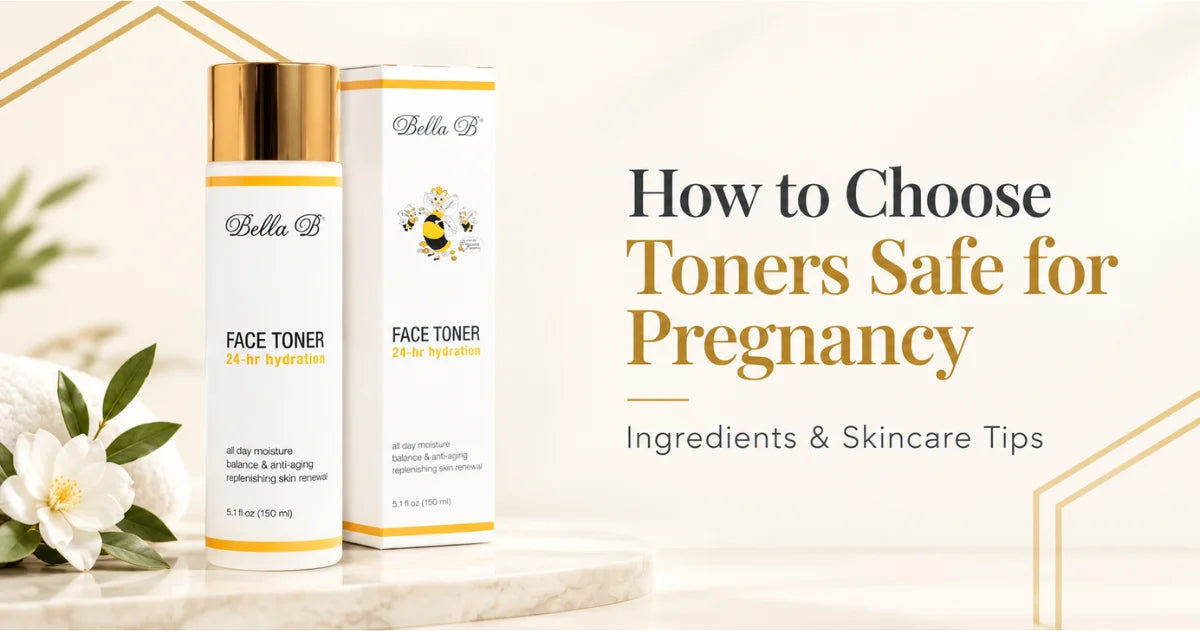
If what you want is hydration rather than aggressive exfoliation, Bella B Face Toner is designed as a gentle option for pregnancy and sensitive skin.
Its formula focuses on hydration and replenishment with organic ingredients, natural oils, fruit and plant extracts, and ocean plant extracts. It's also hypoallergenic and made without artificial fragrance, mineral oil, or parabens.
That's an important difference in positioning. You're not using toner to wage war on your face. You're using it to refresh your skin after cleansing, help it feel comfortable, and prepare it for the moisturizing steps that follow.
And that is often exactly what pregnancy skin needs: less drama, more support.
How to Use Toner During Pregnancy
Keep the routine simple. After cleansing, apply your toner to clean skin using your hands or a cotton pad. Gently pat or sweep it over your face and neck rather than scrubbing. Then follow with your serum or moisturizer.
SIMPLE ROUTINE
Cleanser → Toner → Serum → Moisturizer → Sunscreen in the morning
You don't need to pile several exfoliating acids, serums, treatments, and spot products on top of one another simply because each ingredient is individually considered acceptable. Your skin barrier doesn't care how impressive your skincare shelf looks.
Introduce new products gradually, especially if your skin has become more reactive during pregnancy. If something burns, produces persistent redness, or leaves your skin unusually irritated, stop using it and reassess.


One More Rule: Recheck Products You Already Own
This is probably the easiest pregnancy skincare habit to overlook. Don't only check the new toner you're thinking about buying. Check the one already sitting beside your sink.
Read the full ingredient list of your existing skincare products, particularly anti-aging, acne, exfoliating, and pigmentation treatments. Product formulas can also change over time, so relying on an ingredient list you found online three years ago isn't ideal.
If you need a broader reference point, Bella B's guide to pregnancy safe skincare ingredients separates commonly used ingredients from those that deserve more caution.
And if you find an ingredient you can't confidently identify? Ask. Your OB-GYN or dermatologist would much rather answer a skincare question than have you spend three hours spiraling through contradictory search results at midnight.
The Bottom Line
Choosing toners safe for pregnancy becomes much easier once you stop treating “toner” as one type of product.
Start with what your skin actually needs. For dryness or sensitivity, look toward simple hydrating ingredients such as glycerin, hyaluronic acid, niacinamide, and gentle soothing ingredients. Avoid retinoids and hydroquinone during pregnancy, and treat exfoliating actives with the caution they deserve rather than assuming every acid is automatically forbidden.
Most importantly, don't feel pressured to build an elaborate pregnancy skincare routine. A gentle cleanser, a useful toner if your skin benefits from one, moisturizer, and daily sun protection can go a long way.
Your skincare routine doesn't need its own trimester.
