
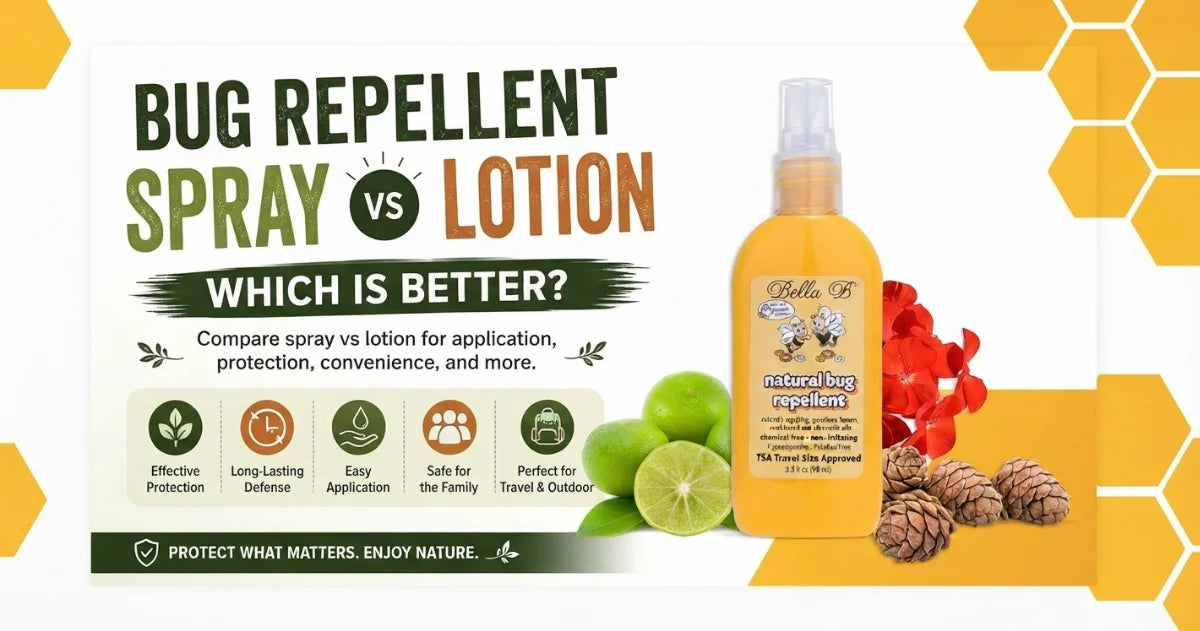
Quick AnswerBug repellent spray is usually better for quick, full-body application, while lotion gives you more precise control over where the repellent goes. Neither is automatically more effective. The active ingredient, concentration, formulation, and correct application matter more than whether you choose a spray or lotion. |
Mosquitoes do not give you much time to debate skincare formats. One minute you are enjoying the backyard, and the next you are wondering whether the spray in your bag would work better than a lotion.
For everyday outdoor time, sprays have one obvious advantage: convenience. Bella B's Buzzy Bee Natural Bug Repellent is a DEET-free spray made with geranium, lemon, cedarwood, and citronella oils. It sprays on quickly and rubs into exposed skin, making it easy to keep nearby for walks, park visits, travel, and family time outdoors.
But convenience is only one part of the bug repellent spray vs lotion decision. If you are wondering which works better, lasts longer, feels better on skin, or makes more sense for mosquitoes, children, or your face, the answer depends on more than the bottle it comes in.
Bug Repellent Spray vs Lotion at a Glance
|
Factor |
Bug Repellent Spray |
Bug Repellent Lotion |
|
Application |
Quick and easy |
Slower but controlled |
|
Large areas |
Easier |
Takes more time |
|
Precise coverage |
Less obvious |
Easier to see and feel |
|
Hard-to-reach areas |
More convenient |
Less convenient |
|
Face |
Apply through hands |
Easy to control |
|
Wind |
May cause overspray |
No overspray |
|
Clothing |
Some products allow it |
Usually skin-focused |
|
Protection time |
Depends on formula |
Depends on formula |
|
Sensitive skin |
Depends on ingredients |
Depends on ingredients |
|
Travel |
Very convenient |
Convenient depending on packaging |
|
Best for |
Fast coverage |
Targeted application |
So, Is Bug Spray or Lotion Better?
Choose spray when speed and easy coverage matter most. Choose lotion when you want more control over exactly where the repellent goes.
For effectiveness, look at what is actually inside the product.
The CDC mosquito guidance recommends EPA-registered repellents containing active ingredients such as DEET, picaridin, IR3535, OLE/PMD, and 2-undecanone when proven protection against mosquitoes is needed.
That means a lotion is not automatically stronger because it feels thicker, and a spray is not automatically more powerful because it covers more skin.
Insect Repellent Lotion vs Spray: Does the Format Affect Protection?
Think of the format as the delivery method.
Spray helps you distribute the product quickly. Lotion lets you rub the product over your skin and see where it has been applied.
The protection itself depends much more on factors such as:
- The active ingredient
- Its concentration
- How much you apply
- How evenly you cover exposed skin
- How long the formula is intended to last
- Sweat, water, and physical activity
- Whether you reapply according to the label
This distinction is especially important when comparing two completely different products.
A botanical spray and a 20% picaridin lotion, for example, are not simply "spray versus lotion." They are two different formulations using different approaches to insect protection.
If you prefer botanical repellents during pregnancy or everyday outdoor use, Bella B's natural bug repellent goes deeper into when a botanical choice may fit and when stronger, EPA-registered protection may be more appropriate.
Bug Spray vs Lotion for Mosquitoes
The bug spray vs lotion for mosquitoes decision becomes much easier when you think about what you are actually doing outside.
Choose a spray if:
You are covering both arms and legs, getting several family members ready, heading out for a walk, or need something you can apply quickly before leaving the house.
Spray also makes it easier to reach ankles, calves, and the backs of your legs.
Choose a lotion if:
You only have a few exposed areas, want to know exactly where the product has been applied, or dislike spraying products around your body.
For mosquitoes, though, the CDC focuses more on proven active ingredients and correct application than on choosing one physical format over another.
So if you are facing heavy mosquito activity or traveling somewhere with mosquito-borne disease, prioritize appropriate protection first. Decide between spray and lotion second.
Which Insect Repellent Lasts Longer?
If your biggest concern is which insect repellent lasts longer, compare the label rather than assuming lotion wins.
Some lotion formulations can provide long-lasting protection, but that does not mean every lotion outlasts every spray.
Picaridin is a good example.
According to the National Pesticide Information Center, picaridin is used in insect repellents for mosquitoes, ticks, biting flies, fleas, and chiggers and can be formulated in several different product formats.
A picaridin lotion may therefore have a different concentration or stated protection time from a picaridin spray sold beside it.
Concentration also matters. The American Academy of Pediatrics notes that higher concentrations of picaridin generally provide longer protection, with 20% products offering substantially longer mosquito protection than lower concentrations.
The useful takeaway is simple:
Do not use texture as a shortcut for protection time. Check the individual product.
When a Bug Repellent Spray Makes More Sense
Spray is hard to beat when everyone is already standing by the door asking if you are ready.
It works especially well when:
- You have large areas of exposed skin
- You need fast application
- You are getting children ready for outdoor time
- You want something easy to carry while traveling
- You need to reach your lower legs or back
- You do not enjoy rubbing in a traditional lotion
Sprays can still benefit from being rubbed over the skin when the product directions recommend it. That helps reduce the chance of leaving small unprotected areas between random sprays.
The main drawback is that wind and poor aim can make coverage less predictable. Apply deliberately rather than spraying a cloud around yourself and hoping enough lands in the right place.
When Lotion May Be the Better Choice
Lotion makes sense when precision matters more than speed.
Because you apply it with your hands, you know exactly which areas have been covered. That can be useful around wrists, ankles, the neck, and other smaller exposed areas.
There is also no airborne mist, which may appeal to people who dislike breathing around sprays.
The downside is obvious: it takes longer.
If you are trying to cover two arms, two legs, and several children before a family hike, rubbing in lotion can become tedious quickly.
This is why insect repellent lotion vs spray does not have one universal winner. Each solves a slightly different application problem.
What Is the Best Bug Repellent for Skin?
The best bug repellent for skin should match your expected insect exposure and be something you are comfortable applying properly.
For a quiet evening on the patio, your needs may be very different from someone hiking through tick country or traveling to an area where mosquitoes can transmit disease.
Start by asking:
How much protection do I actually need today?
Then look at:
- Active ingredients
- Product directions
- Protection time
- Age recommendations
- Skin sensitivity
- How often it needs to be reapplied
For higher-risk mosquito or tick exposure, public-health agencies recommend EPA-registered repellents with proven active ingredients.
For ordinary everyday outings, some families may prefer a botanical option.
The setting should drive the decision.
What About Bug Repellent for Sensitive Skin?
Finding a bug repellent for sensitive skin is less about choosing lotion over spray and more about reading the entire formula.
Either format can contain ingredients your skin likes or dislikes.
If you tend to react easily, consider:
- Fragrance
- Essential oils
- Alcohol or solvents
- Preservatives
- The active ingredient
- Whether your skin is already irritated
Natural does not automatically mean irritation-free either. Botanical ingredients can still bother sensitive skin.
A small patch test can be useful with an unfamiliar topical product, particularly if your skin has become more reactive during pregnancy. Bella B's advice on checking skincare ingredients also explains why the complete ingredient list matters more than broad labels such as "natural" or "clean."
And if your skin already has cuts, rashes, or irritated areas, avoid putting insect repellent directly over them.
What Is the Best Insect Repellent for Face?
Using insect repellent for the face requires more care than spraying your arms or legs.
This is one situation where lotion can feel convenient because you already have precise control with your fingertips.
But you do not necessarily need a lotion.
For spray products, the CDC Yellow Book recommends spraying the product onto your hands first and then applying it to your face, while avoiding the eyes and mouth.
That simple technique gives you much more control and prevents you from accidentally breathing in or spraying the product into your eyes.
Use only enough product to cover exposed skin.
More is not automatically better.
What About Bug Repellent for Kids?
Parents often lean toward lotion because controlled application feels reassuring. But an unpressurized spray can also work well when used correctly.
The American Academy of Pediatrics recommends choosing sticks, lotions, or unpressurized sprays for children and following all label directions.
For facial application, adults should put the repellent on their own hands first and then gently apply it to the child's face.
Repellent should also be kept away from a child's hands, eyes, mouth, and irritated skin.
Age restrictions depend on the active ingredient, so never rely on "natural," "family," or "gentle" wording alone. Check the actual product instructions.
Is Waterproof Bug Repellent Really Waterproof?
People often search for waterproof bug repellent before camping, beach days, pool trips, or hot-weather outings.
But "waterproof" is not something you should assume based on whether the product is a spray or lotion.
Sweating, swimming, and rain can all change how well a repellent remains on your skin. The EPA specifically notes that perspiration and water exposure can affect repellent effectiveness.
So if water is part of your plans, check the label for:
- Water-resistance information
- Reapplication instructions
- Recommended protection time
Do not automatically reapply simply because you got a little wet, and do not assume you remain fully protected after swimming. Follow the directions for that specific product.
Sunscreen and Bug Repellent: Which Goes First?
This is one outdoor-care question with a much clearer answer.
Apply sunscreen first, then insect repellent.
The American Academy of Dermatology recommends applying sunscreen first, allowing it to dry, and then applying insect repellent. It also advises against relying on combination sunscreen-repellent products because sunscreen generally needs to be reapplied more frequently.
So your routine might look like:
- Apply sunscreen.
- Let it settle.
- Apply your insect repellent.
- Reapply each product according to its own instructions.
There is no need to treat them as one product just because you use them during the same outing.
Bug Repellent Spray vs Lotion: The Final Verdict
The winner depends on what you need from it.
Choose bug repellent spray when you want:
- Fast application
- Easy coverage over arms and legs
- Something convenient for family outings
- Better reach
- A travel-friendly option
Choose bug repellent lotion when you want:
- Precise application
- More control over coverage
- No airborne mist
- Easy targeted application on smaller areas
For actual protection, spray versus lotion matters less than the formula, concentration, correct application, and conditions in which you are using it.
So rather than asking only "is bug spray or lotion better?", ask:
Which repellent gives me enough protection for where I'm going, in a format I will actually apply properly?
That is the comparison that matters once the mosquitoes arrive.
