
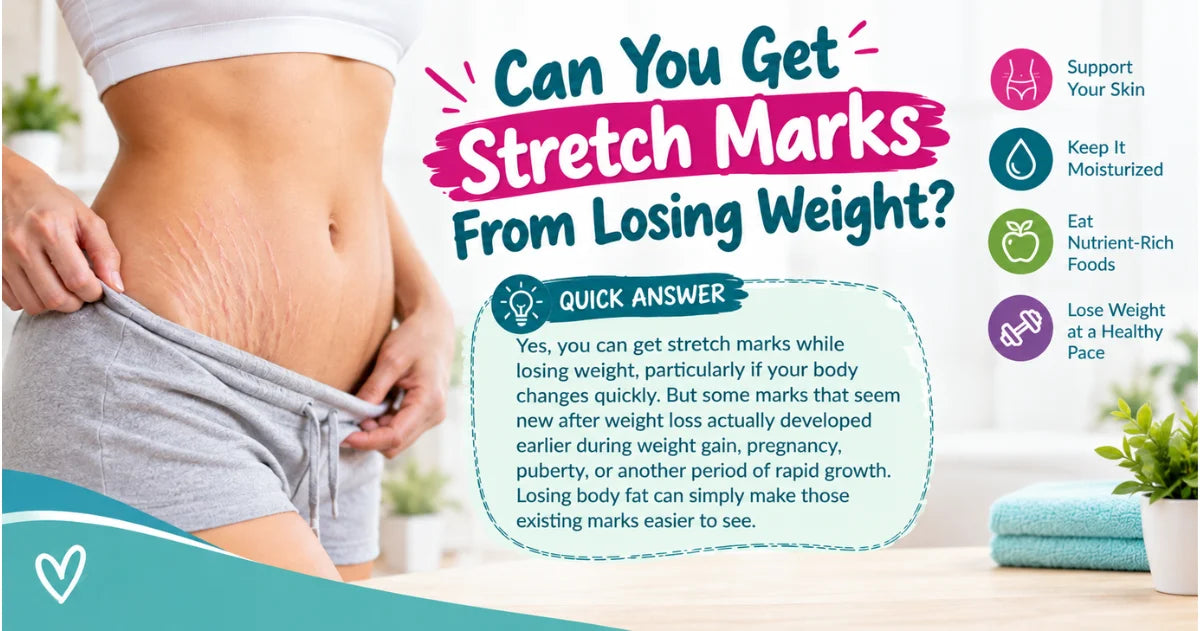
QUICK ANSWERYes, you can get stretch marks while losing weight, particularly if your body changes quickly. But some marks that seem new after weight loss actually developed earlier during weight gain, pregnancy, puberty, or another period of rapid growth. Losing body fat can simply make those existing marks easier to see. |
You lose weight, your clothes fit differently, and then you notice lines across your stomach or thighs that you could swear weren't there before.
So, can you get stretch marks from losing weight?
You can. But weight loss isn't always the moment the stretch mark actually formed.
Your skin responds to changes underneath it. When that change happens faster than its collagen and elastin can comfortably adjust, stretch marks may form. In other cases, losing fat changes the way your skin sits on your body and reveals marks that were already there.
If the skin around your stomach, hips, breasts, or thighs also feels dry or tight while your body changes, keeping it moisturized can make it more comfortable. Bella B's Tummy Honey Stretch Mark Cream is made for dry, stretch-prone areas and can fit into that kind of everyday skin care.
Here's what is actually happening.


Why Can Weight Loss Cause Stretch Marks?
Stretch marks, also called striae, are a type of scar.
They develop in the dermis, the layer of skin that contains much of its collagen and elastin. These proteins help skin stay strong while still being able to stretch.
When your body changes size quickly, those supportive fibers can be disrupted.
Most people associate stretch marks with weight gain because the skin is being stretched outward. But rapid shrinking can affect the skin too. The American Academy of Dermatology lists rapid weight loss among the situations in which stretch marks may develop, and Cleveland Clinic also notes that sudden weight changes can lead to them.
That doesn't mean everyone who loses weight will develop stretch marks.
How quickly your body changes, your genetics, hormones, age, and previous stretching all affect how your skin responds.
|
WHAT THIS MEANS Weight loss can be part of the reason a stretch mark appears, but the number on the scale alone doesn't predict what your skin will do. Speed of change, genetics, hormones, and previous stretching matter too. |
Are They Really New Stretch Marks?
Sometimes. Sometimes not.
This is one of the most confusing parts of weight loss and stretch marks.
Suppose you gained weight over several years. Your skin gradually stretched with it, and faint stretch marks formed around your abdomen or hips. While the skin was fuller and more taut, those lines weren't very noticeable.
Then you lose weight.
The volume underneath the skin decreases. The surface isn't pulled as tightly, and suddenly those same marks stand out more.
Nothing necessarily appeared overnight. You can simply see it now.
Pregnancy can create the same situation. Marks that developed while the stomach or breasts were growing may look different after delivery and postpartum weight loss.
So if you're noticing stretch marks when losing weight, don't assume every line is brand new.
Stretch Marks and Loose Skin Are Not the Same Thing
After significant weight loss, people often use “stretch marks” and “loose skin” as if they mean the same thing.
They don't.
Stretch marks are lines within the skin. They may look red, pink, purple, brown, white, or silver depending on their age and your skin tone.
Loose skin is skin that no longer sits tightly against the tissue underneath it because some of that volume has disappeared.
You can have stretch marks without loose skin. You can have loose skin without stretch marks. And after a large body change, you can certainly have both.
Loose skin can also make existing stretch marks look more noticeable because the surface becomes softer or more folded.
|
STRETCH MARKS |
LOOSE SKIN |
|
Lines or streaks within the skin; often change color as they mature. |
Skin that sits more loosely after the tissue underneath loses volume. |
|
You can have one, the other, or both. |
You can have one, the other, or both. |
Who Is More Likely to Notice Stretch Marks After Weight Loss?
There is no specific number of pounds that guarantees stretch marks.
Some people lose a considerable amount of weight without developing many. Someone else may notice them after a much smaller change.
A few factors matter more than the number on the scale.
Rapid Changes in Weight
Your skin has an easier job when your body changes gradually.
The CDC generally recommends losing about 1 to 2 pounds per week for people pursuing sustainable weight loss.
That isn't a stretch-mark treatment or prevention rule. It is healthy weight-management guidance. Still, gradual change avoids the extreme fluctuations that can put additional stress on your skin.
Genetics
Some families simply seem more prone to stretch marks.
If your mother or siblings developed noticeable marks during pregnancy, puberty, or weight changes, you may be more likely to develop them too.
Bella B's guide on whether stretch marks are genetic explains why family history matters.
Pregnancy and Previous Weight Changes
Skin that has already gone through major stretching may show more visible marks as the body gets smaller.
That's why postpartum women may notice their stretch marks differently as swelling decreases and body composition changes.
If pregnancy is what brought you here, our guide to preventing stretch marks during pregnancy covers that situation in more detail.
Hormones and Certain Medications
Hormones affect collagen and skin structure. Long-term corticosteroid use and some medical conditions can also make stretch marks more likely.
The American Academy of Dermatology recommends medical evaluation when stretch marks develop without an obvious cause.
What Can You Do While Losing Weight?
You can't completely control whether stretch marks form.
That's the part worth knowing before you spend a small fortune on products that promise otherwise.
What you can do is support your skin while your body changes.
Lose Weight at a Sensible Pace
You don't need to lose weight as slowly as humanly possible just to protect your skin.
You also don't need to chase extreme weekly losses.
A steady approach is easier on your body overall and is more consistent with the CDC's weight-loss guidance.
Keep Dry Skin Moisturized
Moisturizer does not guarantee that stretch marks won't develop.
What it can do is make dry, tight skin feel softer and more comfortable.
|
REALISTIC EXPECTATION Think of moisturizer as supportive skin care, not a prevention guarantee. “Keeps dry, stretching skin comfortable” is a useful promise. “Stops every stretch mark” isn't. |
If you're deciding whether topical products are worth using, Bella B's guide on whether stretch mark creams work explains what they can and cannot reasonably do.
Eat Enough Protein and Nutrient-Rich Foods
Skin is living tissue. It needs nutrients just like the rest of your body.
A balanced diet that includes adequate protein, fruits, vegetables, healthy fats, vitamins, and minerals gives your body what it needs to maintain and repair tissue.
There is no special stretch-mark food, supplement, juice, or powder that can promise scar-free weight loss.
Regular food is allowed to be boring and useful at the same time.
Do Stretch Marks Fade After You Lose Weight?
They often become less noticeable, but losing weight itself doesn't remove them.
New stretch marks may begin red, pink, purple, or darker than the surrounding skin. As they mature, they usually flatten and become lighter.
Older marks tend to be white or silvery.
According to Cleveland Clinic, stretch marks can take roughly six to twelve months to fade, although the timing varies.
They may fade considerably. They usually don't disappear completely.
That's because a stretch mark isn't simply discoloration sitting on top of the skin. It is a change in the structure of the skin itself.
What Can Help Existing Stretch Marks?
Treatment depends partly on how old the marks are.
The American Academy of Dermatology notes that treatments such as hyaluronic acid and prescription tretinoin may make some early stretch marks less noticeable.
Dermatologists may also use procedures including laser therapy, microdermabrasion, radiofrequency, or microneedling.
These treatments can improve appearance. They don't erase stretch marks completely.
If you're comparing home care with professional options, Bella B's guide on how to remove stretch marks goes deeper into the differences.
|
PREGNANCY & BREASTFEEDING NOTE If you're pregnant or breastfeeding, talk with your healthcare provider before using retinoids or starting cosmetic procedures. Don't assume a treatment is suitable during pregnancy just because it is sold for skin care. |
When Should You Ask a Doctor About Stretch Marks?
Most stretch marks are harmless and don't require treatment.
Consider speaking with a healthcare professional if you develop a large number of marks suddenly, especially when there hasn't been an obvious change such as pregnancy, puberty, muscle growth, or weight fluctuation.
It is also worth mentioning them if you're using corticosteroids long-term or have other unexplained symptoms.
And if the marks simply bother you, a dermatologist can explain which treatment options are realistic for your skin type and how old the marks are.
So, Can You Get Stretch Marks From Losing Weight?
Yes.
Rapid weight loss can be associated with new stretch marks, but that's only part of the story.
Marks that suddenly catch your eye after weight loss may have formed much earlier and become more visible as the shape and tension of your skin changed.
Either way, you don't need to panic over a few lines.
Lose weight at a sensible pace, eat well, keep dry skin comfortable, and give your skin time to settle into the change.
|
BOTTOM LINE Stretch marks are common. They don't mean you lost weight incorrectly, and they aren't proof that your skin care routine failed. |
