
Quick AnswerYou cannot fully replace washing with wipes, but you can safely bridge the gap between pumping sessions. Wipe flanges and shields down with a breast pump wipe to remove milk residue and reduce bacterial growth, then store the parts in a sealed wet bag or the fridge until you reach a sink. Wash with soap and warm water, and let everything air dry before the next full use. |
If you've ever pumped in a car, an airport lounge, or a break room with no running water in sight, you already know the problem. Milk residue starts drying on your pump flanges within minutes, and you're stuck deciding whether to pack dirty parts away, rinse them in a bathroom sink you don't trust, or reach for something faster.
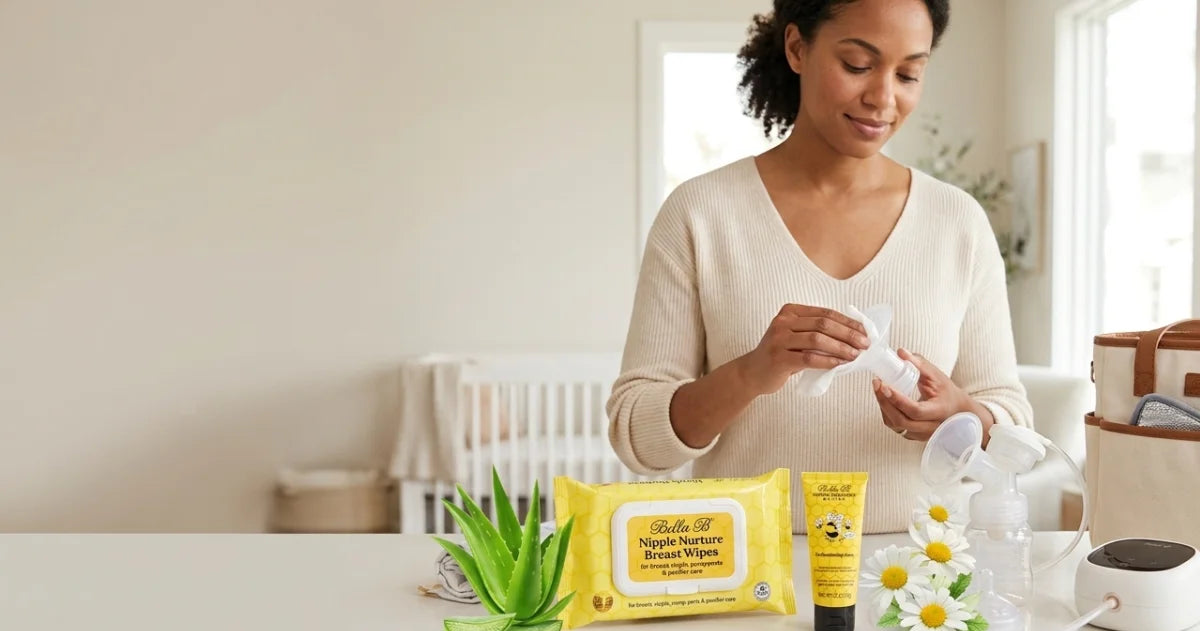
That's exactly where breast pump wipes earn their place in a pumping bag. Bella B's Nipple Nurture Breast Wipes are made for this exact situation: a fast, sink-free way to wipe down flanges and shields between sessions, so you're not carrying visibly soiled parts around for hours.
This guide walks through what the CDC and FDA actually recommend, where wipes fit into that routine, and what to do with your pump parts when a sink simply isn't an option.
Why Sink-Free Cleaning Is Trickier Than It Sounds
Breast milk is a nutrient-dense liquid, which means it's also a comfortable environment for bacteria to multiply if it sits on plastic parts too long.
The CDC's guidance on breast pump hygiene is built around this reality: parts that touch milk, including flanges, valves, membranes, connectors, and bottles, should be rinsed and cleaned as soon as possible after each session, and washed items should never go straight into a household sink because sink basins and drains carry their own bacterial load.
That advice assumes you have a wash basin and running water nearby. Working parents pumping at a desk, in a car, or between flights often don't. That gap is exactly why breast pump wipes and other sink-free habits exist, not as a replacement for washing, but as damage control until you can get to one.
Can You Wipe Down Pump Flanges Instead of Washing?
Not as a permanent substitute. Both the CDC and the FDA are clear that wipes are a convenience tool for when soap and water aren't available, not an equivalent to a full wash.
Even breast pump manufacturers that sell dedicated cleaning wipes note that parts touching milk still need a wash with liquid dishwashing soap and warm water before the next pumping session.
So yes, you can wipe down flanges instead of washing for a single session away from home, but you should plan to wash those same parts with soap and warm water within the same day, ideally before they're used again.
Think of it as two different jobs. Washing removes milk residue and breaks down the film bacteria feed on. Wiping buys you time by keeping that residue from drying and hardening onto the plastic while you're away from a sink.
|
Task |
Breast Pump Wipes |
Full Wash (Soap + Warm Water) |
|
Removes fresh milk residue |
Yes, quickly |
Yes, thoroughly |
|
Breaks down dried bacterial film |
Limited |
Yes |
|
Safe as a same-day solo method |
For a single session only |
Yes, daily minimum |
|
Ideal setting |
Car, office, travel |
Home or a proper wash basin |
Is It Okay to Use Breast Pump Wipes?
Yes, it's okay to use breast pump wipes, and for many parents they're a practical necessity rather than an extra step. Wipes are especially useful when traveling, at work, or in other public places where a quick and effective cleaning solution matters more than a full wash.
The key is understanding their role: they handle the in-between moments, and a proper wash still happens once you're back near soap and water.
If you're using wipes on flanges or breast shields, look for ones that are alcohol-free and formulated without harsh fragrances, since these parts sit close to your skin and eventually touch your baby's milk supply.
Bella B's wipes are also made to double as nipple and skin wipes, so the same pack that cleans your pump parts can refresh sore or tender skin during the same pumping session.
Are Breast Pump Wipes Good for Daily Use?
They're good as a support tool, not as your only cleaning method. Manufacturers and lactation resources generally position wipes for the moments soap and water aren't accessible, then recommend a full wash at least once a day for any parts touching milk.
Wipes are best used away from home or between thorough cleanings, while washing with soap and water should still happen at least once daily for parts that come into direct contact with milk.
Leaning on wipes for one or two sessions during a busy workday is completely reasonable. Skipping washing altogether for days at a time is where the risk starts building.
The CDC Cleaning Guidelines, Step by Step
When you do have access to a sink, the CDC cleaning guidelines lay out a fairly simple sequence:
|
Step |
What to Do |
|
1. Wash hands |
Wash with soap and water for at least 20 seconds before touching any pump part. |
|
2. Disassemble & rinse |
Rinse every piece that touches milk (flanges, valves, membranes, connectors, bottles) under running water. |
|
3. Wash |
Use soap and warm water in a wash basin dedicated to pump parts, never the kitchen sink directly. |
|
4. Rinse again |
Rinse under running water or in a separate basin of clean water until no soap remains. |
|
5. Air dry |
Dry completely on a clean, unused paper towel or drying rack before storing. |
|
6. Reassemble |
Only once everything is fully dry, store in a clean, protected space such as a sealed bag. |
The FDA echoes this same soap and warm water approach and adds a useful clarification: it isn't possible to fully sterilize pump parts at home, even by boiling them, but thorough washing with dishwashing soap and warm water is enough to keep them safe and sanitary without sterilizing. You don't need a sterilizer. You need consistency.
How to Clean Breast Pump Parts Without a Sink
When a sink genuinely isn't available, here's a realistic sequence that keeps you within CDC-aligned hygiene while you're out:
|
Step |
Action |
|
1. Wipe immediately after pumping |
Use a breast pump wipe on the flange, breast shield, valve, and any surface that touched milk. This removes the bulk of the milk residue before it dries onto the plastic. |
|
2. Bag it, don't bare it |
Place wiped parts into a dedicated wet bag or sealable plastic bag rather than loose in your pump bag. |
|
3. Use the fridge hack |
If pumping again soon, store rinsed or wiped parts in a resealable bag inside a break room fridge or a cooler with ice packs. |
|
4. Wash within the same day |
Wash everything with soap and warm water as soon as you're near a sink. Don't let wiped parts go a full 24 hours without a proper wash. |
|
5. Air dry before reassembling |
Lay parts on a clean paper towel, not a cloth towel, which can transfer its own germs. |
What to Do With Pump Parts Between Sessions
This is one of the most common questions working parents have, and the answer depends on your timeline:
|
Timing |
What to Do |
|
Pumping again within 1–2 hours |
A quick wipe with a breast pump wipe, then a sealed bag or the fridge, is generally enough to bridge the gap. |
|
Pumping again later the same day |
Use the fridge hack: store rinsed or wiped parts in a sealed bag alongside your milk, then wash everything with soap and warm water at day's end. |
|
Done pumping for the day |
Wash immediately with soap and warm water rather than waiting until the next morning. |
Some parents ask whether human milk's natural antibacterial properties mean parts can skip cleaning between sessions entirely.
Lactation experts note that milk does have antibacterial activity for a short window after it's expressed, but that protection isn't reliable once residue is exposed to air, heat, or a longer stretch of time, so it isn't a substitute for cleaning.
Cleaning Pump Parts at Work
Office pumping comes with its own obstacles: shared kitchens, no dedicated basin, and limited time between meetings. A few habits make it manageable:
- Keep a small stash of portable breast pump cleaning wipes in your desk drawer or pump bag so you're never stuck without an option.
- Bring a dedicated wash basin and bottle brush for pump parts only, since the CDC and multiple hospital systems, including UT Southwestern Medical Center, specifically warn against washing directly in a shared kitchen sink. Germs in a shared sink and drain could contaminate pump parts, which is why a basin used only for infant feeding items is worth the extra bag space.
- Wipe down the pump's dials, power switch, and the surface it sits on with a disinfectant wipe, especially if it's a shared workplace pump. La Leche League International notes that wiping down the pump and the surface it sits on matters most when sharing an employer-provided pump with others.
- Pack a second set of flanges and valves for longer workdays so you always have a clean set ready, even if the dirty set is waiting in a wet bag until you get home.
Bacteria Growth, Milk Residue, and Why This Actually Matters
It's easy to treat pump cleaning as a chore rather than a safety step, but the stakes are real. Dried milk residue on flanges and breast shields creates a surface where bacteria can multiply, and immunocompromised or very young babies are more vulnerable to the effects.
|
Why It Matters: A Real CDC Case A CDC investigation traced an infant death to a bacterial infection linked to pump parts that had been cleaned in a household sink and reassembled while still damp. The CDC has documented roughly 18 cases of that same rare bacterial infection each year in the United States, most tied to contaminated infant feeding equipment. That's a rare outcome, but it's the reason the CDC cleaning guidelines are so specific about basins over sinks, and full drying before storage. |
Can Dirty Pump Parts Cause Mastitis?
Dirty pump parts don't directly cause mastitis in the way an infection spreads from a wound, but poor pump hygiene and ineffective milk removal are linked risk factors.
Mastitis is most commonly triggered by a blocked duct or incomplete milk removal, often from a poor flange fit or inconsistent pumping, rather than by residue on flanges. ,
That said, damaged, cracked, or improperly cleaned parts can introduce bacteria to already irritated or cracked nipple skin, which raises infection risk in a different way. Keeping parts clean and flanges properly fitted addresses both angles at once.
Do Breast Pump Parts Need to Be Dry Before Use?
Yes. Every major cleaning guideline agrees on this point: pump parts should be completely dry before you reassemble or use them again.
Moisture left inside flanges, valves, or connectors creates the exact damp environment bacteria and mold need to grow, and it's part of why the CDC investigation above involved parts reassembled while still damp.
Air dry parts fully on a clean paper towel or drying rack, never a cloth towel, before putting your pump kit back together.
How Often Should I Replace Pump Parts If Pumping Once a Day?
Most manufacturers recommend replacing valves and membranes every 2 to 4 weeks and flanges or breast shields every 3 to 6 months with regular daily use, though this varies by brand and how many times a day you pump.
Watch for practical signs it's time sooner: valves that look stretched, cloudy, or torn, flanges with visible cracks or a rough feel, or a noticeable drop in suction.
Worn parts are harder to clean effectively, since cracks and pitted plastic can trap milk residue even after a proper wash, so replacing parts on schedule is part of the hygiene routine, not separate from it.
|
Part |
Typical Replacement Schedule |
Replace Sooner If... |
|
Valves & membranes |
Every 2–4 weeks |
Stretched, cloudy, or torn |
|
Flanges/breast shields |
Every 3–6 months |
Cracked, rough, or suction drops |
Choosing Portable Breast Pump Cleaning Wipes
Not all wipes are built the same, and the wrong formula can leave residue of its own. Look for:
- Alcohol-free and fragrance-light formulas, since these wipes touch skin and pump parts that will contact your baby's milk.
- A texture sturdy enough to actually lift residue, not just push it around.
- Multi-use versatility, so the same pack can handle nipple care, pump flanges, and quick surface wipes rather than needing three separate products in your bag.
|
Bella B Pick Bella B's Nipple Nurture Breast Wipes are formulated with organic aloe vera and are free of parabens, lanolin, and petroleum, so they're gentle enough for the nipple and breast area but sturdy enough to wipe down flanges, pacifiers, and other pump-adjacent surfaces. They're also part of the Nipple Nurture Butter and Breast Wipes gift set, which pairs a wipe pack with nipple cream for full breastfeeding and pumping comfort in one bundle. If you're also managing sore or cracked nipples alongside pump cleanup, our guide on nipple butter vs. lanolin breaks down which barrier cream fits your routine. |
The Bottom Line
You don't need a sink at every pumping session to keep your pump parts safe. A breast pump wipe handles the immediate cleanup, a wet bag or fridge hack keeps residue contained until you reach soap and water, and a proper wash with warm water closes the loop each day. Keep the CDC's core rule in mind through all of it: rinse soon, wash with soap and warm water at least once daily, and never store parts until they're fully dry.
Ready to Pack Smarter?
Add Bella B Nipple Nurture Breast Wipes to your pumping bag so you're covered wherever a sink isn't nearby.
